
died c. 303·Feast October 1
Sts. Verissimus, Maxima, and Julia
Three sibling martyrs of Roman-era Lisbon
Overview
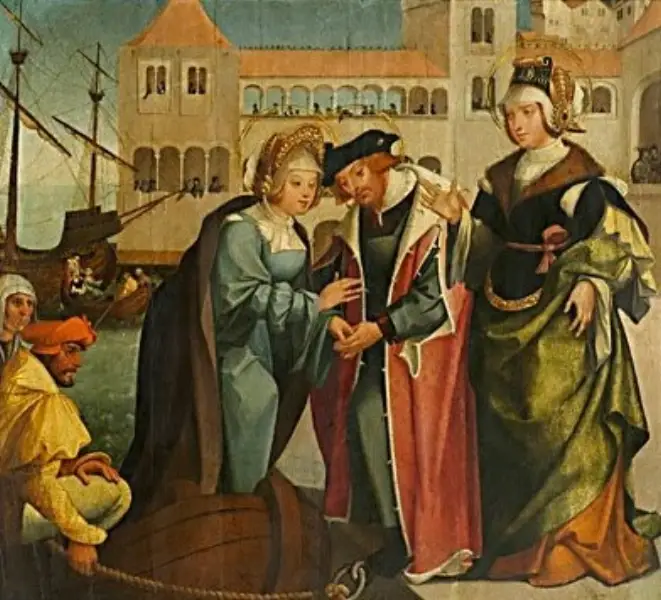
The Holy Martyrs of Lisbon (Santos Mártires de Lisboa) are three Christian siblings — Verissimus, Maxima, and Julia — put to death at Olisipo, the Roman city on the site of modern Lisbon, in the province of Lusitania during the Diocletianic persecution. The traditional account relates that the three were in Rome when an angel directed them to Olisipo, promising the crown of martyrdom they longed for; they sailed there, were soon brought before Tarquinius, the governor under Diocletian, and, on declaring themselves Christians, endured a series of torments before being stoned and having their throats cut. Their cult is remarkably old: the earliest surviving notice of the three appears in the Martyrology of Usuard, and the devotion of Lisbon to its martyrs was strong enough to be recorded in De expugnatione Lyxbonensi, the eyewitness account of the siege of Lisbon at the opening of the Second Crusade. Their relics are honored at the Parish Church of Santos-o-Velho, and their feast is kept on 1 October by Catholics and Eastern Orthodox alike. In about 1530 the painter Garcia Fernandes devoted a celebrated series of canvases to their arrest, passion, and death.
The Complete Life
Summoned from Rome
The legend that has carried the three saints through the centuries begins with a call rather than a command. Verissimus, Maxima, and Julia — brother and sisters, as nearly every account tells it — were in Rome when an angel appeared to them with a strange commission: they were to travel to Olisipo, the Atlantic port of Roman Lusitania, where the martyr's crown they longed for would be granted them. Nothing in the sources explains why such a journey should have seemed desirable, or what tied these Romans to a city at the empire's western edge; the story simply assumes what early Christianity took for granted, that martyrdom was not a misfortune to be avoided but a summons to be answered. The three obeyed, taking ship for Portugal, and their arrival set in motion everything that followed. Whatever history underlies the tale, its shape is the shape of discipleship: a call heard, a journey made, and a faith confessed in a place where the confessors expected to die — and did.
§ History
Before Governor Tarquinius
At Olisipo the siblings were quickly taken into custody and brought before Tarquinius, the governor who administered the province for Diocletian at the height of the great persecution. Their appearance before him was not an accident of circumstance: they had come to voice, in the governor's own hall, their resolve to suffer for the Christian faith. Tarquinius answered with the standard escalation of Roman judicial cruelty, subjecting the three to a series of torments meant to break their confession, and when torment failed, ordered them stoned — and then, the accounts agree, had their throats cut. The manner of their death belongs to the closing years of the persecution that Diocletian unleashed in 303, the last and most systematic attempt of the empire to destroy the Church, and one of the first scenes of Christian Portugal. No acta, no trial transcript, no Roman record survives; the passion of Verissimus, Maxima, and Julia is known only through the devotion of the city that never forgot them.
§ History
A Devotion Older Than the Documents
What is most striking about the three martyrs of Lisbon is how early and how continuously they appear. The first written witness is the Martyrology of Usuard, which carries their names centuries before the era of print; after it comes De expugnatione Lyxbonensi, the vivid account of the 1147 siege in which English and Flemish crusaders helped Afonso Henriques take the city — a text that pauses, in the middle of a military chronicle, to record that Lisbon honored Verissimus, Maxima, and Julia as its own. Neither church nor state ever formally canonized them: theirs is a pre-congregation cult, fixed by the memory of the local church rather than by papal decree. Their relics rest at the Parish Church of Santos-o-Velho in Lisbon, and the Eastern Orthodox Church venerates them alongside Rome. Their endurance in Portuguese memory received its most visible monument around 1530, when Garcia Fernandes painted the series of canvases — Annunciation, disembarkation, passion — of which several survive in Portuguese museums, including the Carlos Machado Regional Museum in the Azores.
§ History
Timeline
- 303
Stoned and slain by having their throats cut at Olisipo after torments ordered by the governor Tarquinius
§ History
- 1530
Garcia Fernandes painted his cycle of the three martyrs' passion, c. 1530
§ Holy Martyrs of Lisbon
The Record
- Symbols
- Palm of martyrdom·Stones and sword (the instruments of their passion)
- Canonization
- Pre-congregation; an ancient cult attested from the early Middle Ages
Prayer
Bibliography
Show 3 sources
- Manuel Batoréo (2010). "A iconografia dos Santos Mártires de Lisboa em quatro pinturas do século XVI: linguagem e significados". Cultura (in Portuguese). 27: 187–199. doi:10.4000/cultura.328
- Cunha, Rodrigo da (1642). "Cap. XVIII: Os martyres Santos Verissimo, Maxima, & Iulia, irmãos, & consortes no martyrio". Historia Ecclesiastica da Igreja de Lisboa (in Portuguese). Lisbon: Manoel da Sylua. pp. 38–41v
- "Orthodox Europe :: Portugal"
Profile text adapted from the Wikipedia article, licensed CC BY-SA 4.0.
Pray with this saint every day
Save Sts. Verissimus, Maxima, and Julia to your favorites, read the full profile, and get feast-day reminders in the Saints app.
Get the Saints AppFree on the App Store for iPhone and iPad