
died c. 362·Feast June 26
Sts. John and Paul
Roman officers-turned-martyrs of the Caelian Hill
Overview
John and Paul, Ioannes and Paulus of the Latin tradition, were Roman martyrs of the fourth century whose memory has been attached to one of Rome's most storied churches ever since. According to their Acts, which are legendary and of uncertain historical reliability, the two served with distinction as military officers, were entrusted by Constantine the Great with the protection of his daughter Constantia, and then retired from public life on a bequest from the imperial family. They built a house on the Caelian Hill and devoted their wealth to works of charity. When Julian the Apostate summoned them back to service, they refused; granted ten days to reconsider, they spent the time dispersing their goods in almsgiving by day and night. The emperor had them beheaded secretly by an official named Terentianus in their own house on the Caelian, where they were buried and a rumor of exile was spread. Whatever the exact year — the Acts place the event under Julian, though some scholars favor Diocletian's persecution — their tomb in the house of Pammachius was venerated by the fifth century, their titulus took their name, and their feast is kept on June 26.
The Complete Life
Officers of Constantine, Guardians of a Princess
The only account of the lives of John and Paul is their Acts, a text the tradition itself labels legendary and possibly unreliable as history, yet one that preserved the shape of their memory for the whole Middle Ages. According to this narrative the two were Romans who served the empire with success as military officers, rising into the confidence of the court itself. Constantine the Great entrusted them with the protection of his daughter Constantia, a post that placed the two soldiers at the center of the imperial family's daily life. Through Constantia they became acquainted with a certain Gallicanus, whom a medieval legend describes as the princess's fiancé and who is said to have built a church at Ostia. Whatever the precise offices they held, the Acts agree that their service won them honor and the imperial favor that would soon transform their circumstances: when the emperor died, the treasure he left them would have been the envy of any Roman senator. The future martyrs appear in the story, in other words, as men of the establishment — connected, trusted, and rewarded — precisely the men whose refusal would later carry the greatest weight.
§ Acts
From the Court to the Caelian Hill
The turning point of the two officers' lives came with money and its renunciation. Constantine bequeathed significant sums to his faithful servants John and Paul; a second version makes Constantia herself the benefactor, bequeathing her fortune to the servants for Christian purposes. Either way, the two men received a fortune at the moment they chose to withdraw from the world. They built a house on the Caelian Hill, one of Rome's ancient residential heights, and retired to private life, devoting themselves and their new wealth to works of charity. The Acts thus present their vocation in two movements: first the acceptance of a great bequest, and then its steady dissolution in almsgiving, a pattern they would complete in their final days. Their house became the setting of everything that followed — the place of their hidden Christian life, the scene of their martyrdom, and eventually the site of one of Rome's oldest titular churches. The senator Byzantius and his son Pammachius, the pious friend of St. Jerome, later fashioned the same property into a Christian basilica, and the ground-floor rooms of the house retained the tomb of the two martyrs.
§ Acts
Ten Days of Almsgiving and a Secret Beheading
Under Julian the Apostate the empire attempted to reclaim its Christian servants, and the two retired officers were summoned to return to military service. They declined. Julian gave them ten days to reconsider — a document of psychological pressure that the Acts preserve with unusual detail. The brothers spent the ten days not in fear but in a final distribution of their wealth, dispersing their goods and giving alms day and night, so that when the deadline came nothing bound them to the world they were leaving. Julian then ordered the execution done quietly: the official Terentianus beheaded both men secretly in their own house on the Caelian Hill, on the 26th of June, the date their feast has kept ever since. Terentianus ordered the two interred on the spot where they fell, then circulated the fiction that the brothers had withdrawn into banishment — an effort to blot out even the testimony of their vanishing. Three Christians who ministered to them were executed as well and buried nearby — Crispus, Crispinianus, and Benedicta — companions in death whose names the Acta Sanctorum would preserve. The secrecy of the procedure could not conceal what had happened for long.
§ Acts
A Tomb Within the Walls and a Name on the Canon
The cult of John and Paul is among the most securely attested of Rome's early martyria, even if the details of their deaths are not. The Sacramentarium Leonianum already indicates in the preface to their feast that the saints rested within the city walls, and the pilgrim guides that list the burial places of Rome's martyrs point the visitor to their resting place in the Caelian church. In the ground-floor apartments of the house of Byzantius, retained beneath the basilica, pilgrims were honoring the two martyrs' grave already in the 400s. Tradition says the remains had been laid beneath the future basilica, inside the house of Pammachius, during the 300s. So completely did the martyrs come to define the place that the titulus Byzantii or Pammachii became known at a very early date by their names — the titulus of Saints John and Paul. By the fifth century their names had been inserted in the Roman Canon itself, the Eucharistic prayer of the city's church, an honor few martyrs received. They were never formally canonized, for they belong to the age before such processes existed.
§ Hagiography
A Basilica, a Venetian Name, and a Piper's Date
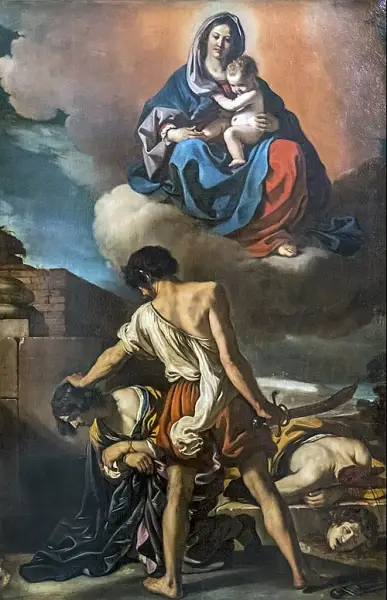
The basilica of Santi Giovanni e Paolo on the Caelian remains the center of the saints' cult, and in the nineteenth century excavators rediscovered beneath it the Roman rooms of the house of Pammachius, decorated with frescoes, with the original confessio of the martyrs covered in paintings of their story; together they rank among Rome's most significant monuments of paleo-Christian memory. Venice honors the pair in the great Basilica di San Zanipolo — 'Zanipolo' being simply Venetian for John and Paul — and veneration of the two has flourished without interruption ever since the Caelian basilica first rose. In 1632 Guercino painted their martyrdom, carrying their story into the visual tradition of the Baroque. Their feast on June 26 entered even secular folklore: the Lüneberg manuscript dates the tragedy of the Pied Piper to 'the day of John and Paul' in 1284, when 130 children of Hamelin were led away. Near Caiazzo in Campania a village bears the name Ss. Giovanni e Paolo, and many of its residents carry the family name San Giovanni — a name carried by emigrants to Michigan, New York, and Florida, spreading the martyrs' memory across the Atlantic.
§ Veneration
Timeline
- 26 Jun 362
Put to the sword in secret within their own Caelian Hill home at the hand of Terentianus on 26 June; the year is disputed, and some scholars prefer Diocletian's persecution to Julian's reign.
§ Acts
- 499
Priests of Byzantius's church put their names to the acts of the Roman synod of 499 and stand recorded in a contemporary inscription — a clergy already attached to a titulus bearing the martyrs' own names.
§ Hagiography
- 26 Jun 1284
An early German account records that 130 children of Hamelin were led away by a piper on the saints' day of John and Paul.
§ Saints John and Paul's Day
In Their Own Words
In 1284 on the day of John and Paul on 26th June / 130 children born in Hamelin were led away / by a piper [clothed] in many colours / to [their] Calvary near the Koppen, [and] lost.
The Record
- Major works
- A house of retirement and charity on the Caelian Hill, funded by imperial bequests
- Canonization
- Pre-congregation; their names have been in the Roman Canon since the 5th century
Prayer
Bibliography
Show 6 sources
- Kirsch, Johann Peter. "Sts. John and Paul." The Catholic Encyclopedia Vol. 8. New York: Robert Appleton Company, 1910.
- Duffy, Patrick. "Jun 26 – Ss John and Paul (4th Century) martyrs", Catholic Ireland, 26 June, 2012.
- Kleinhenz, Christopher (2004). "Constantina". Medieval Italy an Encyclopedia. New York: Routledge. ISBN 978-0-415-93929-4.
- "Biography of the Saints John and Paul", Passio Christi.
- Henschen, Godfrey; et al. (1709). "De sanctis martyribus Romanis Crispo vel Crispino Presbyt., Crispiniano Clerico, et Benedicta Virgine". Acta Sanctorum Junii, Vol. V. Antwerp: Peter Jacobs. p. 258.
- Ashliman, D. L. (ed.). "The Pied Piper of Hameln and related legends from other towns". University of Pittsburgh.
Profile text adapted from the Wikipedia article, licensed CC BY-SA 4.0.
Pray with this saint every day
Save Sts. John and Paul to your favorites, read the full profile, and get feast-day reminders in the Saints app.
Get the Saints AppFree on the App Store for iPhone and iPad