
died c. 304·Feast August 6
Sts. Justus and Pastor
Brother schoolboys martyred at Complutum
Overview
Justus and Pastor were two brothers, schoolboys of the Roman town of Complutum, whose deaths during the Diocletian Persecution made them among the most cherished martyrs of Spain. Justus was thirteen years old; his brother had not yet turned nine. When the imperial edict against the Christians was proclaimed in their city, the two boys left their schoolroom, cast away the writing tablets of their lessons, and ran to the residence of the governor Dacianus to declare themselves followers of Christ. Neither gifts nor threats could move them. They were flogged for renouncing the Roman religion and then beheaded outside the walls, at a field remembered in local tradition as the Campus Laudabilis, on the ground where Alcalá de Henares now stands. Their memory was early honored: the Christian poet Prudentius named them, and the city of Alcalá has claimed them as its patron saints ever since. Relics recovered in the eighth century and restored to the city in 1568 rest today beneath the high altar of the cathedral that bears their name, familiarly called the Catedral de los Santos Niños.
The Complete Life
Schoolboys of Complutum
Complutum, the Roman town on the Henares river whose successor is the Spanish city of Alcalá de Henares, raised the two brothers who would become its glory. They were children of a Christian household in an age when such households lived under the threat of the state. Justus, the elder, was thirteen; Pastor was still short of his ninth birthday. Like other boys of their class they attended school, learning their letters on wax tablets, with the ordinary hopes and games of childhood around them. Nothing else is recorded of their early years, no names of parents, no teachers, no family estate. The silence of the sources makes their story the more striking: what the church remembered was not their upbringing but their choice, the day the proclamation of the emperor's persecution was read out in their city and two schoolchildren decided, together, what it required of them. The Christian poet Prudentius knew and celebrated their memory, evidence that within a few generations the schoolboy martyrs of Complutum had entered the common inheritance of Spanish Christianity. The city that formed them would one day be renamed for its university and its saints, but it knew them first simply as its own boys.
§ Introduction
Witness Before the Governor
The decisive day came when the imperial proclamation of persecution was made public in Complutum. The brothers were at school when the news arrived, and their response has been retold ever since: stirred by the desire to give their lives for Christ, they threw down their writing tablets and ran to the residence of Dacianus, the governor, to bear witness to their faith. Their boldness did not go as children's boldness usually goes. Brought before the official, they confessed themselves Christians and refused to offer sacrifice to the idols, though they knew what such refusal meant. Dacianus tried first the weapon suited to their years: gifts, bribes, the soft persuasion that often succeeds where terror fails. The boys would not be persuaded. Only then came the rod: they were savagely flogged for their denunciation of the Roman religion, and when neither blows nor blandishments had prevailed, both were condemned to death. They were beheaded at a spot outside the town that local tradition preserves under the name Campus Laudabilis, the field of praise, on the site of present-day Alcalá de Henares.
§ Martyrdom
Relics of the Holy Children
The cult of the two brothers took root early and grew deep. In the eighth century relics believed to be theirs were discovered and carried north to Huesca, where they remained for some seven hundred years. In 1568 they were returned in triumph to Alcalá de Henares and placed below the principal altar of the Cathedral-Magistral that bears their name, the church the city knows affectionately as the Catedral de los Santos Niños, the cathedral of the holy children. That building itself is a monument to their memory: begun in 1497 and completed in 1514, it remains in daily use, and the tomb of the brothers is accessible to pilgrims and visitors who descend to it today. The return of the relics in the sixteenth century restored to Alcalá a treasure the city regarded as inseparable from its identity, for the holy children were its patrons and its proudest boast. From the cathedral the story of the two schoolboys has gone on being told, in sermons, in books, and in the street names and feast days of the city that grew up over their blood.
§ Veneration
A Cult That Crossed Borders
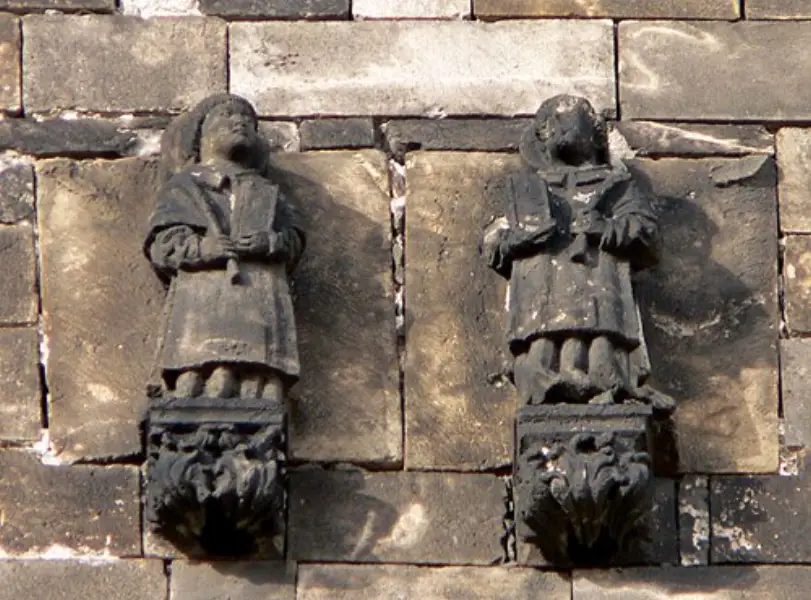
The memory of Justus and Pastor did not stay within the walls of Alcalá. In Barcelona a basilica was raised in their honor in the sixteenth century, built in the Gothic style and still known as the Basilica of Saints Justus and Pastor; the bell tower of its church carries sculptures of the two brothers. Far beyond Spain, the cathedral of Narbonne in the south of France is dedicated to them, testimony to how widely the story of the child martyrs of Complutum traveled through the medieval church. At home their patronage of Alcalá de Henares has never lapsed, and their feast on 6 August has kept their names in the calendar of the universal church. The endurance of that memory found an unexpected modern echo in the 2001 film The Others, in which the story of the two martyrs is read aloud to children within the drama, one of whom objects that they were foolish to die rather than lie. Even such a skeptical retelling proves the point: fifteen centuries on, the choice of the two schoolboys still provokes hearers to ask what their own faith is worth.
§ In popular culture
Timeline
- 304
Flogged and beheaded outside Complutum during the Diocletian Persecution after refusing to sacrifice to idols
§ Martyrdom
- 1497
Construction began on the church that became the Cathedral-Magistral of Saints Justus and Pastor at Alcalá de Henares
§ Veneration
- 1514
The cathedral building was completed; it remains in daily use
§ Veneration
- 1568
Relics returned from Huesca and buried below the cathedral's principal altar
§ Veneration
- 2001
Their martyrdom story appeared in the film The Others, read aloud by one of the child characters
§ In popular culture
The Record
- Patron of
- Alcalá de Henares
- Canonization
- Pre-congregation; ancient martyr cult recorded by the poet Prudentius
Prayer
Bibliography
Show 4 sources
- Butler, Alban. "SS. Justus and Pastor, Martyrs", The Lives of the Saints. vol. VIII, 1866.
- "Saints Justus and Pastor", H.M. Magazine.
- Anguita Jaén, José María; Martínez Ortega, Ricardo (1997). "In Campo Lavdabile et in Campo Letorie". Revista de Filología de la Universidad de La Laguna (15): 12.
- "The Others (2001) Review", decentfilms.com.
Profile text adapted from the Wikipedia article, licensed CC BY-SA 4.0.
Pray with this saint every day
Save Sts. Justus and Pastor to your favorites, read the full profile, and get feast-day reminders in the Saints app.
Get the Saints AppFree on the App Store for iPhone and iPad