
died 29 January 363·Feast January 25
Sts. Juventinus and Maximinus
Imperial guardsmen martyred under Emperor Julian
Overview
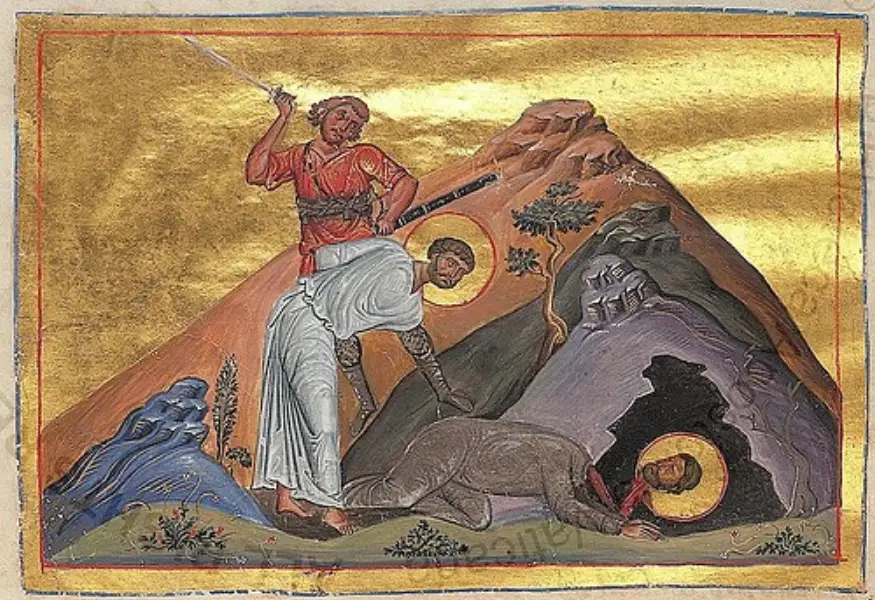
Saints Juventinus and Maximinus were Christian soldiers of the imperial guard of Emperor Julian, and among the last men put to death for the faith by a Roman ruler. In the winter of 362-363, as Julian prepared his campaign against the Sassanid Empire from his headquarters at Antioch, he issued an edict forbidding the veneration of relics in that city and ordered the foodstuffs of the marketplace and the water of the wells sprinkled with blood from pagan sacrifice. At a banquet, the two guardsmen let fall a remark on the emperor's laws against the Christians, asking aloud what sense life made when everything holy was despoiled and the air reeked of sacrificial smoke. Denounced to the emperor, they were summoned before him, and neither persuasion nor the threat of ruin could move them to retract their words or offer sacrifice to the gods. The Roman Martyrology records the sentence: loss of all their goods, a scourging, and death by the sword; John Chrysostom adds that the execution was carried out under cover of darkness and dressed up as a treason case, since the emperor wished to hide the religious motive of their death. They suffered on January 29, 363, a few months before Julian's own death in Persia.
The Complete Life
Christians in the Imperial Guard
Juventinus and Maximinus served among the picked soldiers of Emperor Julian's imperial guard, members of the armed household of the man the Christian tradition remembers as the apostate. Their service placed them in an exposed position after Julian's accession in 361, for the new emperor set about restoring the old cults of the empire and restricting the religion of the Christians. At Antioch, the base from which he prepared his great campaign against the Sassanid Empire, his policy took forms designed to wound: an edict prohibited the veneration of the relics honored in that city, and orders were given that the foodstuffs of the marketplace and the water of the wells be sprinkled with blood offered to idols, so that no Christian could eat or drink in the city without contact with sacrifice. In the officers' quarters and at the emperor's table, the two guardsmen watched this campaign unfold from within the very institution charged with enforcing it. Their faith survived the discipline of service to a hostile master, and when the moment came they chose to say openly what most malcontents only thought, a frankness that set them apart from the crowd of grumbling courtiers and marked them for the trial that followed.
§ Introduction
The Banquet and the Beheading
The end came quickly once the two soldiers had spoken. At a banquet they let fall their complaint against the emperor's edicts, lamenting that everything holy was despoiled and that nowhere could a Christian breathe clean air. Being informed of what they had said, Julian sent for them, but neither the emperor's arguments nor any threat of loss or advancement could wring from them a withdrawal of their words or a single offering to the gods. The sentence that followed, as the Roman Martyrology tells it, deprived the two men of their goods, had them flogged, and ended at the executioner's blade. John Chrysostom, who preached a panegyric in their honor, supplies a detail that reveals the emperor's calculating cruelty: the execution was timed for midnight and disguised as a treason prosecution, since Julian had no wish to hand the Christians new martyrs or to let it be known that the two had died for their religion rather than for any crime. They died on January 29, 363. Within months the emperor himself was dead in Persia, and the last pagan persecution had passed with him, its final victims the two guardsmen of Antioch.
§ Introduction
Between Panegyric and Silence
The memory of Juventinus and Maximinus had a distinguished advocate in John Chrysostom, who wrote a panegyric concerning them and argued from their midnight execution that even Julian's hostility bore witness to the power of the Christian name. Their cult found a fixed place in both the Western and Eastern calendars: the Latin Church keeps their feast on January 25, and Eastern Orthodoxy commemorates them on October 9. Their historical footprint, however, is narrow in a revealing way. The Roman historian Ammianus Marcellinus, a contemporary and a participant in Julian's Persian expedition, makes no mention of them, nor do Gregory of Nazianzus or the church historian Socrates of Constantinople, so that the story rests on the liturgical and homiletic tradition rather than on the classical narrative histories. Modern scholarship has given their legend a further reach: the Italian scholar Pio Franchi de' Cavalieri argued that the Passion of Sergius and Bacchus took shape upon the framework of a now-vanished passio of the two soldiers, its writer borrowing from the martyr-acts of Julian's persecution rather than from those of Galerius. An old and erroneous companion, the fictitious saint Xynoris, once thought martyred alongside them, has been set aside by the same critical tradition.
§ Introduction
Timeline
- 363
Julian's edict against Christian veneration defiles the markets and wells of Antioch on the eve of his Persian campaign
§ Introduction
- 29 Jan 363
Beheaded at Antioch after refusing to retract their words or sacrifice to the gods
§ Introduction
In Their Own Words
Does life make any sense nowadays? All things holy are despoiled. Our faith in the Lord of Creation is treated with contempt and disgrace. Wherever one is, one inhales the ugly smell of animal fat and sacrificial meat. Nowhere can one find any fresh air.
The Record
- Canonization
- Pre-congregation; recognized as martyrs by both the Catholic and Eastern Orthodox Churches
Prayer
Bibliography
Show 4 sources
- Teitler, H. C. (2017). The Last Pagan Emperor: Julian the Apostate and the War against Christianity. Oxford University Press. ISBN 9780190626525
- Butler, Alban (1866). 'St. Juventinus and St. Maximinus, Martyrs'. The Lives of the Saints
- 'Martyr Juventinus at Antioch'. Orthodox Church in America
- Pio Franchi de' Cavalieri. Scritti agiografici, Volume I (1893-1900)
Profile text adapted from the Wikipedia article, licensed CC BY-SA 4.0.
Pray with this saint every day
Save Sts. Juventinus and Maximinus to your favorites, read the full profile, and get feast-day reminders in the Saints app.
Get the Saints AppFree on the App Store for iPhone and iPad