
died c. 270·Feast January 19
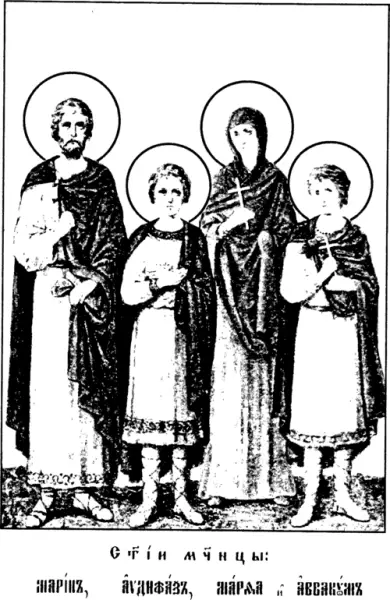
Sts. Marius, Martha, Audifax, and Abachum
Persian family martyred together at Rome
Overview
Marius, Martha, Audifax, and Abachum were four saints of one household — a married couple and their two sons — who came from Persia to Rome and died there as martyrs, according to a largely legendary sixth-century passio. Moved by sympathy for the Christians suffering in the city, the family assisted the condemned and buried the bodies of the executed, an act of mercy that exposed them to the persecution they had come to console. Seized and brought before the judge Muscianus, or in some versions Marcianus, they refused every persuasion to deny their faith and were condemned to torture. Marius and his two sons were beheaded on the Via Cornelia and their bodies burned; Martha, separated from them, was killed thirteen miles from the city at a place called Nymphae Catabassi, later known as Santa Ninfa, where tradition says she was cast into a well. A Roman lady named Felicitas gathered the half-consumed remains and buried them secretly on her estate at Buxus, today's Boccea. The family is commemorated together in the Roman Martyrology on 19 January, and their relics are honored at Rome, Seligenstadt, and Prüm Abbey.
The Complete Life
A Household from Persia
The four saints honored together were, by the account of their sixth-century passio, members of a single Christian family from Persia: Marius and his wife Martha, and their two sons, Audifax and Abachum. They lived in the third century within the Parthian Empire, where Christianity had taken root among the eastern peoples, and their Persian origin has remained fixed in their cult, which numbers them among the eastern martyrs of the Roman church. In some sources Marius bears the name Maris, and the order of the sons is sometimes given differently, variations typical of a story transmitted through many martyrologies. What the tradition consistently preserves is the picture of a complete household — father, mother, and sons — whose faith was not a private inheritance but a common conviction carried across the miles of the journey they undertook together. Little more can be said of their life before Rome: the brevity of their recorded history is itself part of their witness, for the sources know them almost entirely by the charity and the death that brought their journey to its end.
§ Veneration
Pilgrims of Mercy
The family's story in Rome begins not with preaching but with compassion. Coming from Persia to the capital of the empire, they found the Christian community there suffering through the condemnation and execution of its members. Rather than keeping apart from danger, Marius, Martha, and their sons attached themselves to the victims: they sympathized openly with the confessors and martyrs, assisted those condemned for the faith, and gathered and buried the bodies of the executed, honors that Roman law and Roman suspicion alike made hazardous. This service of mercy — the visitation of prisoners, the care of the dying, the burial of the dead — was the vocation by which they earned their own crown. It was precisely this assistance to the Christians that exposed them to the attention of the authorities and drew down the persecution they had come to relieve. In the logic of the passio, the pilgrims who had crossed the world to comfort the martyrs of Rome were found worthy to take their place among them, a family completing in blood the work of charity it had begun.
§ Veneration
Torture and Execution
The family was seized and delivered to the judge Muscianus, called Marcianus in some versions of the story, who tried first to persuade them to renounce their faith. When persuasion failed, he condemned them to various tortures; under torment they still refused to abjure. The sentence then fell upon them in two places. The sword fell upon Marius and both his sons beside the Via Cornelia, and what remained of them was given to the flames, the destruction of the remains being intended to prevent the honors that Christians paid their dead. Martha was put to death separately at a place called Nymphae Catabassi, later known as Santa Ninfa, thirteen miles from Rome; tradition adds that she was cast into a well, making her death a drowning as well as an execution. Some ancient martyrologies place the family's death between 268 and 270, in the reign of Claudius II, though the sources note that no general persecution of Christians was then underway — one of the many details by which the critical reader discerns the legendary character of the narrative. The substance remains: a household that would not deny Christ and paid for it together.
§ Veneration
In the Martyrologies
The cult of Marius, Martha, Audifax, and Abachum is ancient, resting on a foundation of names, places, and a date rather than on verifiable history. The Church knows with certainty only their names, their resting place in the Ad Nymphas cemetery beside the Via Cornelia, and the date on which they were laid there, either the nineteenth or the twentieth of January. On that basis they were inscribed in the Roman Martyrology on 19 January, and their feast or commemoration stood in the General Roman Calendar from the ninth century until the liturgical reform of 1969, when they were excluded precisely because so little of their story can be established. The removal from the universal calendar did not erase them: the Roman Martyrology continues to record the four on their day, and their cult survives in the churches dedicated to their memory. Their history illustrates the cautious devotion of the Church toward her early martyrs — veneration sustained across more than a millennium, a legend retold for centuries, and finally an honest reckoning with the limits of what the evidence can carry, without the loss of the names themselves.
§ Veneration
Relics from Boccea to Prüm
According to tradition, a noble Roman woman named Felicitas gathered what the fire had left of the father and his sons, together with the mother's body taken up from the well, and laid these sacred remains to rest in secret on her property at Buxus, today's Boccea, the day after the executions. A church arose at the site in time, and through the Middle Ages it drew pilgrims to the graves of the Persian family. The relics themselves knew a long history of division and removal: portions were transferred to the Roman churches of Sant'Adriano al Foro and Santa Prassede, and part of these were sent to Eginhard, the biographer of Charlemagne, who placed them in the monastery of Seligenstadt. Other relics reached Prüm Abbey, where their presence is recorded from the early eleventh century. At Prüm the first reliquary there met its end amid the French occupation of the late 1700s, and the chest venerated on the altar today was fashioned in the 1800s. In Rome their memory is kept in the church of Santi Mario e Compagni Martiri, named for Saint Marius and his companion martyrs, which carries their story into the present life of the city.
§ Veneration
Timeline
- 270
Marius and his sons Audifax and Abachum were beheaded on the Via Cornelia and their bodies burned.
§ Veneration
- 20 Jan 270
The Roman lady Felicitas secretly interred the family's remains on her estate at Buxus, today's Boccea.
§ Veneration
- 1969
Their commemoration was removed from the General Roman Calendar because nothing certain is known beyond their names, burial place, and burial day.
§ Veneration
The Record
- Canonization
- Pre-congregation martyrs; inscribed in the Roman Martyrology on 19 January.
Prayer
Bibliography
Show 7 sources
- Clugnet, Léon. "Sts. Maris, Martha, Audifax, and Abachum." The Catholic Encyclopedia Vol. 9. New York: Robert Appleton Company, 1910
- Father Alban Butler: Saints Marius, Martha, Audifax, and Abachum
- Martyrologium Romanum, Typis Vaticanis, 2004, p. 106
- Calendarium Romanum, Typis Polyglottis Vaticanis, 1969, p. 113
- "Santi Mario, Marta, Abaco e Audiface"
- Holweck, F. G., A Biographical Dictionary of the Saints. St. Louis, MO: B. Herder, 1924.
- Herbermann, Charles, ed. (1913). "Sts. Maris, Martha, Audifax, and Abachum". Catholic Encyclopedia. New York: Robert Appleton Company.
Profile text adapted from the Wikipedia article, licensed CC BY-SA 4.0.
Pray with this saint every day
Save Sts. Marius, Martha, Audifax, and Abachum to your favorites, read the full profile, and get feast-day reminders in the Saints app.
Get the Saints AppFree on the App Store for iPhone and iPad