
died c. 286·Feast June 18
Sts. Mark and Marcellian
Twin deacons martyred under Diocletian
Overview
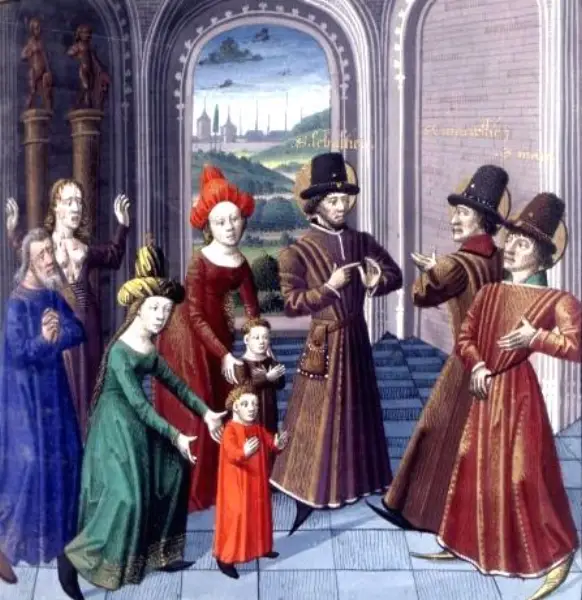
Mark and Marcellian, honored in Latin as Marcus and Marcellianus, were twin brothers of a distinguished Roman family who served the early Church as deacons and died as martyrs under the emperor Diocletian, most probably in the year 286. Their story, told in the ancient though largely legendary Acts of St Sebastian, relates that they were arrested for refusing sacrifice to the Roman gods, and that even their parents, Tranquillinus and Martia, came to their prison urging them to give way. The deacon Sebastian instead confirmed them in their faith and became the instrument of a remarkable series of conversions around their trial, including their own parents, the official Nicostratus and his wife Zoe, and the household of the prefect Chromatius. Betrayed after a period of concealment, the twins were condemned to be bound head downward to pillars with their feet nailed in place; they hung for a full day before being pierced with lances. Their grave was made on the eighteenth of June in the cemetery of Saint Balbina along the Ardeatine Way, and their memory has stood in the martyrologies ever since, with a feast on 18 June in the Roman Catholic Church and 18 December in the East.
The Complete Life
Twin Deacons of Rome
Mark and Marcellian were twin brothers, born in Rome into a family of distinction and standing in the city. They reached maturity in the decades when the Christian community of the capital, though periodically exposed to persecution, had long been established and organized, with its cemeteries along the roads leading out of the city and its clergy serving the faithful. Both brothers were ordained deacons of the early Church, an office that bound them to the service of the bishop and the daily care of the Christian people — the ministry of the table, of charity, and of the word. Their parents, Tranquillinus and Martia, were still living when the persecution under Diocletian broke over the Church at the end of the third century, and the family's ties made the brothers' trial the more painful, for the same blood that bound them to each other bound them to those who could not yet understand their constancy. Of their lives apart from this crisis nothing certain remains; the Acts that tell their story are ancient but largely legendary, and the Church knows them surely only by their names, their office, and their death.
§ Legend
Prison and the Voice of Sebastian
After the brothers declined to worship the gods of the Roman state, they were seized and shut up in prison. Their predicament drew from an unexpected quarter: their own father and mother, Tranquillinus and Martia, came to them in their chains and urged them to renounce their Christianity and save their lives, pleading as parents rather than as pagans. Into this anguish of divided loyalties came Sebastian, the soldier who would himself win the martyr's palm, and by his exhortation the twins were confirmed in their resolution not to abandon the faith. The grace of that hour proved contagious. Sebastian converted Tranquillinus and Martia themselves, so that the parents who had begged their sons to yield became believers in the cause they had opposed. To Tiburtius, son of Agrestius Chromatius, said to be prefect of Rome, the faith came in the same way, as it did to the official Nicostratus and his wife Zoe — a woman who had been mute for six years and who, having made known her desire for the Church, recovered her speech as soon as she was converted. Nicostratus brought forward the rest of the prisoners under his charge, sixteen souls who likewise accepted the faith at Sebastian's hands.
§ Legend
A Harvest in the Prefect's House
The witness of the imprisoned deacons spread far beyond their own cell. Chromatius and his son Tiburtius became converts to the Christian faith, and the transformation reached even into the machinery of the persecution itself: Chromatius set free all the prisoners he held, resigned the position he occupied, and withdrew to Campania to live apart from the service of the state. The legend thus presents the twins' martyrdom as a seed that fruited before it was sown — officials converted, captives released, and a household turned from idols while the confessors still lived. The Christian officer Castulus joined the company of the faithful and concealed the twin brothers when the search for them resumed. The narrative places around the deacons a whole constellation of Roman Christians — Tranquillinus, Martia, Nicostratus, Zoe, Castulus, Tiburtius, and Chromatius — whose cults were afterwards associated with theirs, though the official liturgical books of the Church mention only Mark and Marcellian among the saints for 18 June. Whatever the historical value of each detail, the story remembers a simple truth: the courage of two brothers in bonds became the occasion of faith for many who watched them.
§ Legend
Betrayal and the Pillars
The concealment granted by Castulus did not last. An apostate named Torquatus betrayed the hiding place of the twin brothers, and they were taken into custody a second time, their first confession now doubled by the charge of escape. The condemnation was pronounced by Fabianus, named in the legend as Chromatius' successor in the prefecture, though he does not appear in the historical list of Rome's prefects. The sentence was contrived for cruelty: the twins were bound head downwards to two pillars, their feet nailed to the wood, and left hanging in that position for a full day. When neither pain nor shame had moved them, the execution was completed with lances, and the brothers who had endured the day together died together beneath the steel. Their bodies were buried on the Via Ardeatina, near the cemetery of Domitilla, in the cemetery of Santa Balbina, and the day of their burial, 18 June, became the day of their feast. The legend adds the fates of their companions in the faith: Zoe died bound to the branch of a tree with flames kindled beneath her feet; Nicostratus, with five companions, met death by drowning in the Tiber; and Tiburtius was entombed alive in a ditch.
§ Legend
Among the Ancient Martyrs
Mark and Marcellian belong to the company of Roman martyrs whose cult the Church received from the earliest generations, without formal canonization and upon the simple evidence of name, death, and grave. They appear in nearly all the old martyrologies, the Roman Martyrology among them, where the pair are named first of the saints honored on 18 June; that date had been theirs in the General Roman Calendar from an age earlier than the Tridentine reform. The story of their passion, preserved in the Acts of St Sebastian, is ancient but largely legendary, and the Church has always weighed it accordingly: in the 1969 revision of the calendar their mention was set aside, since only three things about them carry certainty: what they were called, that they died as martyrs, and that they were laid in the cemetery of Saint Balbina by the Ardeatine Way on 18 June. This removal did not deny their sanctity; the Roman Martyrology continues to commemorate them, and their cult, sometimes linked with those of Tranquillinus, Martia, Nicostratus, Zoe, Castulus, and Tiburtius, remains alive in the calendars of both the Roman Catholic and the Eastern Orthodox Church, which keep their memory on 18 December.
§ Veneration
The Tomb at Santi Cosma e Damiano
The relics of the two martyrs found their way from the Via Ardeatina into the heart of the city: the remains of the two brothers were transferred, most likely at some point in the ninth century, to the church of Santi Cosma e Damiano, the ancient titulus in the Roman Forum dedicated to the twin physician saints. There, in 1583, in the reign of Pope Gregory XIII, their remains were rediscovered, a find that renewed the devotion of late sixteenth-century Rome to the brothers of the Diocletianic persecution. The bodies remain in a tomb in that church, set near an ancient painting depicting the two martyrs with a third figure who appears to be the Virgin Mary — an image that has kept their faces before the faithful through the centuries. In 1902 a further discovery recalled them to their first resting place: their basilica in the catacombs of Saint Balbina, where they had been buried on the Via Ardeatina, was found again after long obscurity. Thus the two brothers are remembered at both ends of their journey, in the cemetery basilica where their grave first stood and in the Forum church where their relics rest today.
§ Veneration
Timeline
- 286
Martyred at Rome under Diocletian after refusing to sacrifice to the Roman gods.
§ Legend
- 18 Jun 286
Laid to rest in the cemetery of Saint Balbina along the Via Ardeatina, close by the cemetery of Domitilla.
§ Legend
- 1583
Their bodies were discovered at the Church of Santi Cosma e Damiano in Rome, in the reign of Pope Gregory XIII.
§ Veneration
- 1902
The basilica that held their grave in the catacombs of Saint Balbina came to light once more.
§ Veneration
- 1969
Their mention in the General Roman Calendar was removed because nothing is known of them beyond their names, martyrdom, and burial.
§ Veneration
The Record
- Canonization
- Pre-congregation martyrs; listed in the ancient martyrologies and the Roman Martyrology for 18 June.
Prayer
Bibliography
Show 6 sources
- Saints, December 18, Justin Popović (in Serbian)
- Martyrologium Romanum, Libreria Editrice Vaticana (2001), ISBN 88-209-7210-7
- Calendarium Romanum, Libreria Editrice Vaticana (1969), p. 127
- Clugnet, Léon. "Sts. Mark and Marcellian." The Catholic Encyclopedia. Vol. 9. New York: Robert Appleton Company, 1910
- Ebenezer Cobham Brewer, A Dictionary of Miracles: Imitative, Realistic, and Dogmatic, Chatto and Windus (1901), 11
- Herbermann, Charles, ed. (1913). "Sts. Mark and Marcellian". Catholic Encyclopedia. New York: Robert Appleton Company.
Profile text adapted from the Wikipedia article, licensed CC BY-SA 4.0.
Pray with this saint every day
Save Sts. Mark and Marcellian to your favorites, read the full profile, and get feast-day reminders in the Saints app.
Get the Saints AppFree on the App Store for iPhone and iPad