
c. 30 – c. 67·Feast July 2
Sts. Martinian and Processus
Jailers of the apostles, martyrs of Rome
Overview
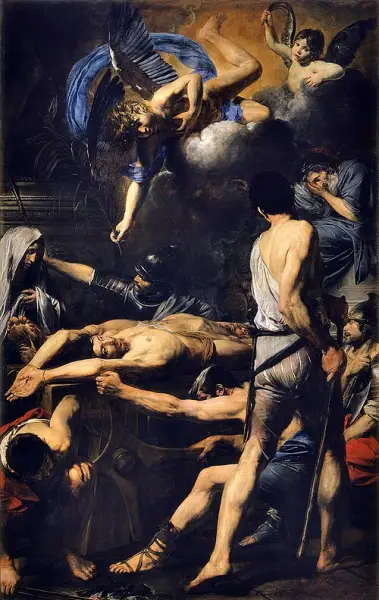
Martinian and Processus were Christian martyrs of ancient Rome about whom almost nothing of historical certainty survives: history records neither when they lived nor how they died. The legend that grew up around them makes them soldiers of the Praetorian Guard assigned as warders of Saints Peter and Paul in the Mamertine Prison. When a spring flowed miraculously within the prison, the apostles converted their jailers, and Peter baptized them in the miraculous water; Nero then had the guards arrested, tortured, and beheaded in their turn, and a Christian woman, Lucina, gave them burial in her family's cemetery. Their names appear under July 2 in the Martyrologium Hieronymianum, and the old catalogues of Roman burial places record their grave at the second milestone of the Via Aurelia. They were venerated publicly in Rome from at least the fourth century, when a church was raised over their tomb, and Gregory the Great preached there on their feast. Pope Paschal I translated their bones to the old Basilica of St. Peter, and in 1605 their remains were set in a porphyry urn beneath the altar that bears their name in the present basilica, where they rest today.
The Complete Life
Warders Converted in the Mamertine
The story that gives the two saints their place in Christian memory is told of their service in the Mamertine Prison, the ancient state jail at the foot of the Capitoline. According to legend, Martinian and Processus were soldiers of the Praetorian Guard detailed to guard Saints Peter and Paul during the apostles' imprisonment under Nero. Their conversion came through a miracle: a spring welled up miraculously within the prison, water in the deepest dungeon of Rome, and in that water Peter baptized the two men who had been set to watch him. The jailers became disciples, and the change cost them their lives. On the emperor's command they were seized in their turn, put to the torture, and beheaded, sealing with blood the faith they had received from their prisoners. After their martyrdom, a Christian woman named Lucina buried them in her own cemetery. Modern scholarship treats the narrative as legend rather than history, for the dates of the men and the manner of their deaths are unknown, but the tale preserves the early Roman conviction that even the guards of the apostles belonged to the company of the saved.
§ Legend
Burial on the Via Aurelia
What can be known of the two martyrs rests on their burial. They were originally laid to rest in a cemetery of the apostolic era along the Via Aurelia, and their feast was kept on July 2, the date the Martyrologium Hieronymianum gives for their names and the day on which the old catalogues record their grave. The Bollandist Hippolyte Delehaye and the Roman Martyrology record their grave as lying in the Cemetery of Damasus, though the year of burial cannot be fixed, at the second milestone of the road; the Berne manuscript of the Martyrology names as alternatives that same second milestone, or else the catacombs of St. Agatha which stand on the Via Aurelia, and the early catalogues of where Rome's martyrs were laid likewise list the tombs of the two saints beside this highway out of the city. Their deaths are placed by tradition in the persecution of Nero, around the year of Peter and Paul's own martyrdom, and an early sympathizer, Lucina, is named as the woman who gave them a grave in her family cemetery. On this modest foundation of a name, a date, and a burial place by the western road, the whole later cult of the two saints was built.
§ Burial
From the Via Aurelia to St. Peter's
Veneration of the two martyrs in Rome is ancient, attested publicly from the fourth century and perhaps from the third. A church rose over their tomb, and there, on their feast day, Gregory the Great preached a homily that stands as evidence for the cult: the pope referred to the presence of the saints' bodies, to the cures of the sick worked at the shrine, to the harassment of perjurers, and to the deliverance of demoniacs. The church itself has disappeared. In the ninth century Pope Paschal I had the bones of the two martyrs carried into a chapel of the old St. Peter's, protecting them as Rome's churches stood exposed to attack, and they were among the saints whose remains were gathered into the great church of the apostle. When the present St. Peter's Basilica rose, their relics were installed in a porphyry urn below an altar of the right transept in 1605, an altar flanked by two antique yellow columns and surmounted by roundels showing scenes from the life of Paul. The 1969 reform of the General Roman Calendar removed their separate feast, grouping the early martyrs of the city with the First Martyrs of the Church of Rome on June 30, yet their names remain in the Roman Martyrology, and they may still be honored with their own Mass on July 2.
§ Veneration
Timeline
- 67
According to legend, the two Praetorian soldiers were arrested on Nero's orders, tortured, and beheaded after their baptism by Peter.
§ Legend
- 300
The two martyrs were honored publicly in Rome from the fourth century onward, and possibly even from the third.
§ Veneration
- 400
A church was built over their tomb on the Via Aurelia.
§ Veneration
- 600
Gregory the Great preached a homily at their church on their feast day, describing cures and the presence of their bodies.
§ Veneration
- 824
Pope Paschal I had the bones of the two martyrs brought to a chapel within the old Basilica of St. Peter.
§ Veneration
- 1605
Their relics were laid in a porphyry urn below the altar of St. Peter's Basilica, which a pair of antique yellow columns flank.
§ Veneration
- 1969
The revision of the General Roman Calendar removed their individual feast but kept their names in the Roman Martyrology.
§ Veneration
The Record
- Major works
- Church raised over their tomb on the Via Aurelia (fourth century)·Altar of Saints Processus and Martinian in St. Peter's Basilica
- Patron of
- Invoked, with Processus, against perjury, on the evidence of Gregory the Great's homily on cures and the harassment of perjurers at their shrine
- Symbols
- Palm of martyrdom·Military dress of Praetorian soldiers·Chains of the Mamertine Prison
- Canonization
- Pre-congregation; publicly venerated in Rome from the third or fourth century and listed in the Roman Martyrology.
Prayer
Bibliography
Show 7 sources
- Burger, John (26 June 2020). "The bones of the jailers of St. Peter are beneath this altar in Rome". Aleteia — Catholic Spirituality, Lifestyle, World News, and Culture.
- Calendarium Romanum (Libreria Editrice Vaticana, 1969), p. 128.
- David Hugh Farmer, "The Oxford Dictionary of Saints" (Oxford: Clarendon Press, 1978), p. 337.
- De Rossi, "Roma sotterranea", I, pp. 182–3.
- Lipsius, Richard, Apokryphe Apostelgeschichten und Apostellegenden, II (Brunswick, 1887), pp. 92, 105 et seq., 110 et seq.
- Martyrologium Hieronymianum (ed. G. B. de Rossi – L. Duchesne), p. 85.
- Martyrologium Romanum (Libreria Editrice Vaticana, 2001, ISBN 88-209-7210-7).
Profile text adapted from the Wikipedia article, licensed CC BY-SA 4.0.
Pray with this saint every day
Save Sts. Martinian and Processus to your favorites, read the full profile, and get feast-day reminders in the Saints app.
Get the Saints AppFree on the App Store for iPhone and iPad