
martyred c. 303–311·Feast Varies by locality
Sts. Agapius, Timolaus and Companions (the Martyrs of Palestine)
Martyrs of the Diocletianic Persecution in Caesarea
Overview
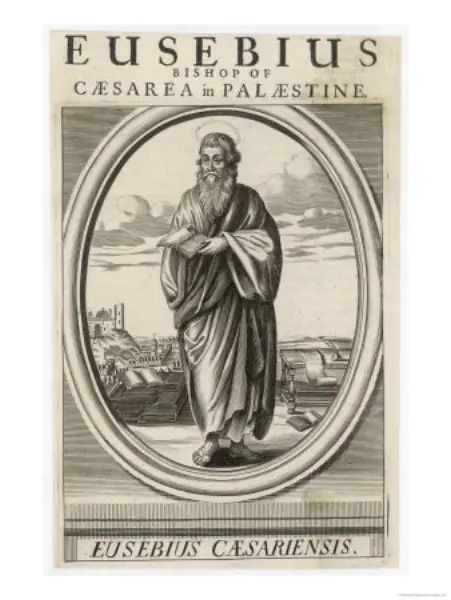
Under the emperor Diocletian, the church of Caesarea in Palestine became a proving ground of Christian constancy. Eusebius, bishop of Caesarea and the foremost historian of the early Church, stood in the city while his fellow Christians were arraigned, tortured, and put to death, and afterwards he set down what he had seen in a work devoted wholly to these witnesses. His account preserves the names of individual martyrs: Agapius, killed in 303 or 304 together with Timolaus and their companions; the band who surrendered themselves voluntarily to the magistrates; Alphaeus and Zacchaeus; Peter Apselamus; Procopius of Scythopolis; Romanus of Caesarea; and Silvanus of Gaza, a priest who died for his ministry. Eusebius framed the narrative as a debt owed to his own country, closing with the hope that Christians everywhere would learn what Palestine had endured and that the record would make his people proud. The text took its final shape after the persecutions ceased in 311 and was published around 315 or 316; a fuller version, unknown for centuries, came to light again in 1866.
The Complete Life
The Tribunal at Caesarea
When Diocletian's persecution reached Palestine, Caesarea, the capital of the province and the city where Eusebius lived, became the stage on which the contest between empire and conscience was fought out. Christians were brought before the Roman magistrates, ordered to sacrifice, and, on refusal, condemned to torment and execution. Among those who died was Agapius, put to death in 303 or 304 alongside Timolaus and a band of companions whose names the record keeps — two men called Alexander, a Dionysius, Plaesius, Romulus, and another Dionysius. Elsewhere in the province the same tribunals claimed others: Alphaeus and Zacchaeus; Peter Apselamus; Procopius of Scythopolis; Romanus of Caesarea; and Silvanus of Gaza, who died as a hieromartyr, a priest put to death for his priesthood. Eusebius watched these events from within the afflicted community and wrote as a witness who had stood in the same streets. He refused to record anything that did not, on his own account, vindicate the divine judgement, and so what he left behind is not a mere register of executions but a portrait of a church under sentence of death, holding its confession intact while the machinery of the state labored to break it.
§ Introduction
A Company That Gave Itself Up
The shorter account preserves something the longer one does not: the story of Timolaus and his companions, remembered as voluntary martyrs. These were not Christians hunted down and dragged before the judges; they came forward and offered themselves, a form of witness that startled even their own generation. Their surrender of life without waiting for arrest belonged to the most radical edge of early Christian martyrdom, and Eusebius judged it worthy of a place in his narrative even in the abridged form of the story that circulated with his Ecclesiastical History. In the fuller version of his work the same theme is deepened rather than diminished: the cruelty of the persecutors and the endurance of the suffering Christians are entered into with far greater detail, so that the reader sees both the apparatus of coercion and the patience that outlasted it. The spirituality these pages record is one of settled resolve — a conviction that the body could be broken only after the faith had already been secured beyond the reach of any tribunal. That steadiness, more than any single dramatic act, is what the martyrs of Palestine handed on to the churches that remembered them.
§ Short recension
After the Storm
The ordeal of the Palestinian church did not last forever. By 311 the persecutions in Caesarea had ceased, and only afterwards did Eusebius compose the longer account of what his city and his province had suffered, publishing it in 315 or 316. The work is striking for the intimacy of its standpoint. Where the abridged text speaks of the city in the third person, the full recension says our city of Caesarea and this our country, the language of a man writing about his own neighbors and his own streets. The martyrs are not distant exemplars but people he might have known. Eusebius ends the book by saying that he hopes to make his land known to Christians elsewhere in the world, and that through the work the whole people of Palestine may take pride in what was endured within it. Death in the arena of the local court is thus transformed into a possession of the whole church, a memory entrusted to the universal communion rather than left to fade in one province. The two tellings then went their separate ways: the shorter text traveled with his Ecclesiastical History, while the fuller recension kept an independent existence, which is why it could disappear for well over a thousand years before surfacing again in the nineteenth century.
§ Long recension
The Honest Witness
The record of the Palestinian martyrs has been argued over for as long as it has been read. Eusebius announced plainly that he would pass over whatever did not serve his purpose of vindicating the divine judgement, and this frankness about his own selectivity troubled later readers. Edward Gibbon, writing in the eighteenth century, trusted the work not at all for precisely this reason. In the nineteenth century, however, Joseph Barber Lightfoot looked at the same passages and reached the opposite verdict, commending Eusebius for the very honesty of declaring his principle of selection in advance. Whatever a historian makes of the author, the martyrs themselves keep their place in the record. The long version of the story, missing for well over a thousand years, surfaced again in 1866 and restored to readers the fuller, local voice in which Caesarea spoke of its own dead. Through that recovery, the named witnesses — Agapius, Timolaus and their companions, Alphaeus and Zacchaeus, Peter Apselamus, Procopius, Romanus, and Silvanus of Gaza — remain known by name sixteen centuries after their deaths. For later generations the work remains the chief window onto the ordeal: without it, the names that have come down — Agapius, Timolaus, Peter Apselamus, Romanus, Silvanus, and their companions — would long ago have dropped from the memory of the wider church.
§ Reliability
Timeline
- 304
Agapius of Palestine is put to death along with Timolaus and their companions — two men named Alexander, Dionysius, Plaesius, Romulus, and a second Dionysius
§ See also
- 311
The persecutions in Caesarea come to an end, after which Eusebius composes the longer account of the martyrs
§ Background
- 315
The long recension is published, issued in 315 or 316 once the ordeal of the church had passed
§ Background
- 339
Eusebius of Caesarea, eyewitness and historian of the Palestinian martyrs, dies at about seventy-six
§ Introduction
- 1866
The long recension of the martyr narrative, lost for centuries, is rediscovered
§ Introduction
In Their Own Words
which may be useful first to ourselves and afterwards to posterity
the whole people of Palestine
The Record
- Canonization
- Pre-congregation; honored from antiquity through the eyewitness record of Bishop Eusebius of Caesarea
Prayer
Bibliography
Show 8 sources
- "On the Martyrs of Palestine". Eusebius of Cæsarea. Catholic Encyclopaedia, 1912. Retrieved 19 April 2013.
- Gemeinhardt, Peter, ed. (2012). Christian Martyrdom in Late Antiquity. Walter de Gruyter. p. 55. ISBN 978-3110263510.
- Eusebius. "Martyrs of Palestine, short recension". Retrieved 19 April 2013.
- Wace, Henry and William Smith, ed. (1880), A Dictionary of Christian Biography, Literature, Sects and Doctrines: Eaba-Hermocrates, p. 320.
- Eusebius. "Martyrs of Palestine, long recension". Retrieved 19 April 2013.
- Bonar, Chance (2025-05-20). "The Father of Church History was Palestinian". EVERYDAY ORIENTALISM. Retrieved 2026-05-30.
- Edward Gibbon, Decline and Fall, vol. 1, chapter 16.
- "J.B. Lightfoot, Eusebius of Caesarea". tertullian.org. Retrieved 2008-02-01.
Profile text adapted from the Wikipedia article, licensed CC BY-SA 4.0.
Pray with this saint every day
Save Sts. Agapius, Timolaus and Companions (the Martyrs of Palestine) to your favorites, read the full profile, and get feast-day reminders in the Saints app.
Get the Saints AppFree on the App Store for iPhone and iPad