
died 117·Feast July 27
Sts. Maurus, Pantalemon and Sergius
Martyrs of Bisceglie on the Adriatic
Overview
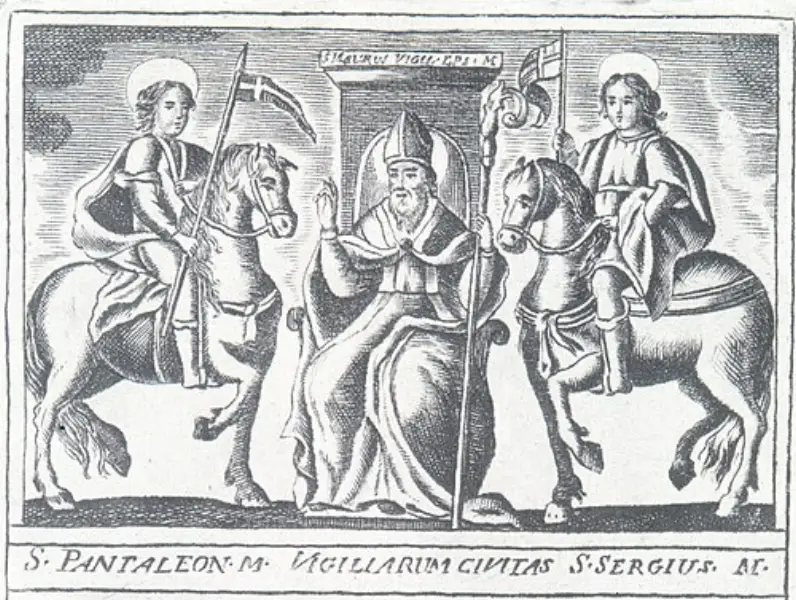
Maurus, Pantalemon and Sergius are second-century Christian martyrs venerated at Bisceglie, a town on the Adriatic coast of Apulia in southern Italy. Tradition holds that Maurus came from Bethlehem in Judea and was sent by the Apostle Peter to be the first bishop of Bisceglie, while his companions Pantalemon and Sergius belonged to the region itself. All three suffered execution when the emperor Trajan persecuted the Christians of his empire, dying on 27 July 117. The church of Bisceglie has kept their memory ever since: the cathedral of the town is their major shrine, their feast is celebrated on 27 July, and they are counted among the pre-congregation saints shared in honor by the Roman Catholic Church and the Orthodox Church. In sacred art the three are shown together, Maurus in the robes of a bishop holding a book, flanked by Sergius and Pantalemon in military attire, mounted on horseback and raising a flag bearing a red cross on a white background, the emblem that their cult gave to the city they sanctified with their blood.
The Complete Life
A Bishop Sent from Bethlehem
The tradition of Bisceglie holds that Maurus came from Bethlehem in Judea, the town of Christ's birth, and that he was sent by Peter himself, the prince of the apostles, to be the first bishop of Bisceglie, a harbor town on the Adriatic coast of Apulia. If the memory is exact, it makes Maurus one of the earliest bearers of the gospel into southern Italy, a missionary dispatched in the apostolic age from the church of Jerusalem and Rome to the far shore of the Mediterranean. His companions in honor, Pantalemon and Sergius, belonged by the same tradition to Apulia itself, men of the country who joined the bishop from Bethlehem in the faith and in his fate. The three thus stand together as the spiritual founders of the Christian community of Bisceglie: one who arrived bearing the apostolic commission, and two sons of the region who gave the young church its first witnesses. Whatever the historical layers beneath the story, the people of Bisceglie have counted these three as their own from the beginning, and their cathedral remains their major shrine to the present day.
§ Introduction
Death Under Trajan
Trajan's persecution of the church cost these three saints their lives; his reign from the end of the first century into the second marked an early and formative period of trial for the young church. Tradition fixes their death at Bisceglie on 27 July in the year 117, the last year of Trajan's rule, so that their martyrdom falls among the oldest commemorated in the Italian church. The date has never left the community's memory: the feast of Maurus, Pantalemon and Sergius is kept on 27 July, the anniversary of the day the three died together. Their cult is shared by the Roman Catholic Church and the Orthodox Church, a rare convergence that witnesses to the antiquity of their veneration, which belongs to the era before formal canonization and rests wholly on the memory handed down in the local church. For the Christians of Bisceglie the three martyrs were not distant figures from a Peristyle of legend but the founding dead of their own city, whose blood was understood to have consecrated the ground on which the cathedral and the town stood.
§ Introduction
The Banner of Bisceglie
The veneration of Maurus, Pantalemon and Sergius took permanent form in the art and civic identity of Bisceglie. The cathedral of the town is their major shrine, the center of the cult of the three martyrs who are honored as the city's patron. In sacred art they are represented in a striking composite image: Maurus appears in the robes of a bishop with a book, the emblem of his teaching office as first bishop of the city, while Sergius and Pantalemon are shown in military attire, mounted on horseback and raising a flag with a red cross on a white background. The banner the two soldier saints hold became part of the heraldic identity of Bisceglie itself, so that the emblem of the martyrs' cult and the emblem of the town are one and the same. Their feast on 27 July gathers the community each year around the memory of its founding witnesses. In the long gallery of southern Italian martyr cults, that of Bisceglie is distinguished by this union of apostolic mission, soldier companionship and civic banner, a testimony that the three saints have never been separated from the life of the city they sanctified.
§ Introduction
The Record
- Patron of
- Bisceglie, Apulia
- Symbols
- Maurus in bishop's robes holding a book·Sergius and Pantalemon in military attire on horseback raising a flag with a red cross on a white background
- Canonization
- Pre-congregation
Prayer
Bibliography
Show 1 sources
- "Saint of the Day, July 27: Maurus, Pantelemon and Sergius", SaintPatrickDC.org, retrieved 2012-03-06
Profile text adapted from the Wikipedia article, licensed CC BY-SA 4.0.
Pray with this saint every day
Save Sts. Maurus, Pantalemon and Sergius to your favorites, read the full profile, and get feast-day reminders in the Saints app.
Get the Saints AppFree on the App Store for iPhone and iPad