
died c. 305–311·Feast September 10
Sts. Menodora, Metrodora, and Nymphodora
Three sister virgin martyrs of Bithynia
Overview
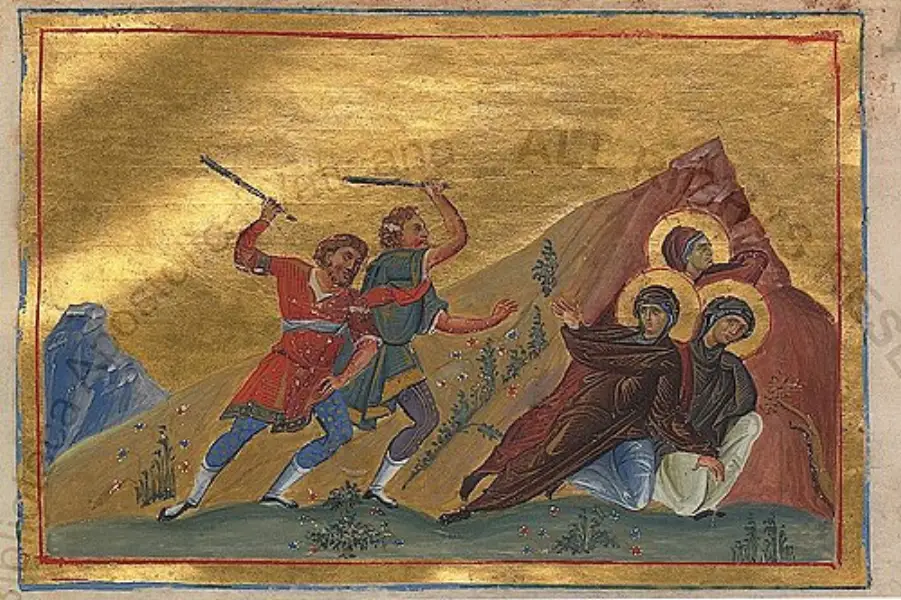
Menodora, Metrodora, and Nymphodora were three sisters of Bithynia, in Asia Minor, who died as martyrs around the years 305 to 311. Tradition relates that they chose not to marry but preserved their virginity, withdrawing from settled society to live as solitaries in the wild — pictured in some tellings as desert, in others as a mountainside — where they gave their days to prayer, fasting, and the spread of God's word. Their reputation for healing the sick through prayer drew wide attention, and word of the holy women reached Frontonus, the pagan governor of Bithynia. He ordered them arrested and brought before him, and when promises of reward failed to shake their faith, he had them tortured and beaten to death one after another: first Menodora, the eldest, then Metrodora, and last Nymphodora. The governor ordered the bodies burned, but a sudden storm extinguished the flames, and a bolt of lightning struck Frontonus and his servant dead. Christian hands gathered up the bodies and laid them to rest beside Bithynia's warm springs. Venerated by Catholics and Orthodox alike, the sisters are commemorated on 10 September in some calendars and on 23 September in others, and portions of their relics are preserved to this day on Mount Athos.
The Complete Life
Three Sisters Who Chose the Wilderness
Menodora, Metrodora, and Nymphodora were sisters of Bithynia, the ancient region along the southern shore of the Sea of Marmara in Anatolia. According to the tradition that preserves their memory, the three made a shared and remarkable choice: they would not marry. Renouncing the ordinary future of women of their time, they retained their virginity for God and left civilization altogether, withdrawing to live alone in the wilderness. The accounts differ on the setting of their retreat — some describe them as dwelling in the desert, others on a mountain — but all agree on the shape of their common life. Their days were given to prayer, to fasting, and to spreading the word of God, a hidden apostolate carried on far from the towns and villages of the province. Three sisters living as hermits was itself a striking witness in a pagan land, and it marked them out long before any official took notice of them. Their family bonds, far from dissolving in the solitary life, became the very structure of their consecration: whatever trials came would come to all three together, and the courage of one would be the strength of the others until the end.
§ Legend
Healers Whose Fame Reached the Governor
In their retreat the sisters were not idle, and their reputation grew beyond the wild places they had chosen. Prayer, it was said, brought healing through their hands, and the afflicted who sought them out found relief through the intercession of the holy women. Word of the sisters and of these cures spread through Bithynia, and fame of the kind they attracted could not remain a private matter in a province under Roman rule. Report of them came to Frontonus, Bithynia's pagan governor and proconsul, and he resolved to act. He ordered the women arrested and brought before his tribunal, intending to deal with this unlicensed influence as the law of the old religion allowed. The encounter set the power of the empire against three unarmed women, and the governor no doubt expected the usual result. What his tribunal in fact met was a faith that promises could not buy and threats could not bend. The healing ministry that had drawn the crowds of Bithynia to the wilderness was about to receive its final and most persuasive testimony, sealed not in words but in the blood of the three healers themselves, one after another before their sisters' eyes.
§ Legend
Martyrdom One by One
Brought before Frontonus, the sisters were first offered rewards if they would renounce their faith, and they steadfastly refused. The angered governor resolved to break them in turn, beginning with Menodora, the eldest. She was stripped and beaten until life left her, and her lifeless body was then displayed before the two survivors in the hope of frightening them into submission. They refused again, and Metrodora was beaten to death in her turn. Nymphodora, the last of the three, was neither swayed by the governor's renewed offers nor terrified by the bodies of her sisters, and she too was beaten to death for her refusal. Three deaths, each witnessed by the sister who would next be called to endure it, accomplished in a single series what no argument of the governor had achieved: the unmoved confession of the Christian faith. Frontonus then ordered the women's bodies burned. But as the pyre was lit a tempest broke over the place; downpour quenched the fire, and lightning descended on the governor and his servant, killing them both. Christians came forward and took up the martyrs' remains, laying them to rest by Bithynia's warm springs, where the memory of the three sisters began its long afterlife.
§ Legend
Relics on Athos and Feasts in East and West
The veneration of Menodora, Metrodora, and Nymphodora passed from the warm springs of Bithynia into the enduring life of the churches of East and West. Both the Roman Catholic Church and the Eastern Orthodox Church number them among the martyrs, and their feast is kept on 10 September in some calendars and on 23 September in others, a doubled observance that reflects the antiquity of their cult. Their martyrdom was thought worthy of depiction in the grandest monuments of Byzantine piety: a miniature in the menologium of Basil II, executed in 985, shows the three sisters beaten to death by the men of Frontonus, and an icon from the early seventeenth century also portrays them. Their bodily remains have not been forgotten. Portions rest in the Protection cathedral of the Russian house of St. Panteleimon on the Holy Mountain of Athos, where their memory has been kept for centuries, and the hand of Metrodora is treasured at the Pantocrator monastery. Thus the sisters who once hid from the world in the wilderness of Bithynia are honoured today at the most storied holy mountain of Orthodoxy — three ascetics whose shared vocation ended in a shared crown.
§ Relics
Timeline
- 305
Beaten to death at Bithynia under the governor Frontonus, within the years c. 305–311
§ Legend
- 985
Their martyrdom was depicted in a miniature of the menologium of Basil II
§ Legend
The Record
- Canonization
- Pre-congregation; venerated as martyrs by the Roman Catholic and Eastern Orthodox churches from antiquity
Prayer
Bibliography
Show 4 sources
- "Martyrs Menodora, Metrodora, and Nymphodora, at Nicomedia". Orthodox Church in America. Retrieved 2025-05-31.
- "Saint virgins Menodora, Metrodora and Nymphodora". St. Elizabeth Convent. Retrieved 2025-05-31.
- "Martyrs Menodora, Metrodora, and Nymphodora at Nicomedia | Ancient Faith Ministries". www.ancientfaith.com. Retrieved 2025-05-31.
- "Greek Orthodox Archdiocese of Australia". Archived from the original on 2016-03-03. Retrieved 2008-02-28.
Profile text adapted from the Wikipedia article, licensed CC BY-SA 4.0.
Pray with this saint every day
Save Sts. Menodora, Metrodora, and Nymphodora to your favorites, read the full profile, and get feast-day reminders in the Saints app.
Get the Saints AppFree on the App Store for iPhone and iPad