
6th century·Feast Thursday before Whitsun
Sts. Mybbard and Mancus
Cornish hermits and companion martyrs
Overview
Mybbard and Mancus were two saints of the sixth century whose memories are joined in the old traditions of Cornwall. Mybbard, whose name is also written Mewbred, Mebbred and Meubred, and who is known in some lists as Calrogus, was a hermit said to be the son of a king of Ireland; he is honoured as a local Cornish saint and is remembered as patron of Cardinham, where the church of St Meubred claims his shrine. Mancus, also written Manaccus or Manaccan, was a monk and abbot of Caer Gybi at Holyhead in Anglesey, a Welsh saint who worked with St Cybi, and who may be the same man as Mybbard's companion Mancus, a hermit in Cornwall. The two are bound together by the tradition of their martyrdom: they are said to have been beheaded along with a third companion at the order of Melyn ys Kynrede, a pagan chieftain; the place of their suffering lies within the present-day bounds of the parish of Lanteglos-by-Fowey, by Fowey. Their commemoration falls on the Thursday before Whitsunday, shared with St Wyllow, who is said to have suffered at the same time; Mancus has also a feast on 14 October.
The Complete Life
Hermits of Two Coasts
Mybbard belongs to that generation of sixth-century Celts among whom the eremitical life was the highest form of Christian ambition. The traditions make him the son of a king of Ireland, one of those royal sons who abandoned inheritance for a hermit's cell, and William Worcester, the fifteenth-century antiquary, records him precisely so: an Irish king's son who exchanged his father's court for a hermit's life in Cornwall. Later retellings reinvented him as an Irish prince in a more romantic mould, but the kernel of the story is the flight from rank to solitude. He is called Calrogus in some lists, and his memory settled at Cardinham, where he is honoured as patron. Mancus, his companion in the Cornish tradition, has a separate and better-documented double in Wales: Manaccus was a monk of the sixth century, abbot at Caer Gybi on Holyhead in Anglesey, who worked alongside St Cybi of Caernarvon. Whether the Welsh abbot and the Cornish hermit were one man or two is a question the sources leave open; what is certain is that the parish of Manaccan in Cornwall bears the name of a saint of this cult, and that the two figures share a feast and a legend.
§ Manaccus
Martyrdom at Lanteglos
The tradition of Cornwall records that Mybbard suffered beheading together with two companions at the hands of Melyn ys Kynrede, the pagan lord of the district; the site falls within Lanteglos-by-Fowey as its bounds run today, close by the harbour at Fowey on the Cornish coast. The legend belongs to the family of the cephalophore martyrs, the saints whom medieval devotion showed carrying their severed heads; William of Worcester prefaced his account of the three with the saying that there were three brothers bearing the name of St Genesius, every one of whom carried his own head, one being an archbishop of Lismore. With them, and by the same tradition beheaded at the same time, suffered St Wyllow, whose cult at Lanteglos kept the same memory. Mybbard is said to lie within the shrine of the church of St Meubred at Cardinham, on the Bodmin Moor edge of Cornwall, while for Mancus two places contested the honour: Lanreath church, standing two miles out from Fowey, claims the body on the authority of Robert Bracey, while the canons of Launceston insisted instead that his grave lay in the parish of Lanteglos. The dispute itself is evidence of how early and how widely the memory of the martyrs was cherished.
§ Meubred
Glass, Parishes, and a Shared Feast
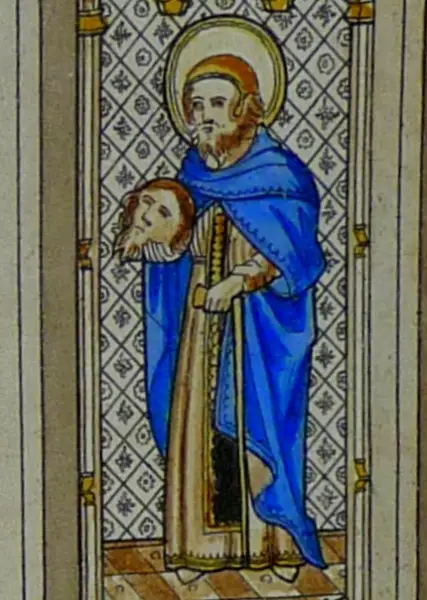
The cult of the two saints survives in monuments that can still be seen. In the church of St Neot, Mybbard appears in stained glass beside St Mabyn, shown carrying an extra head in his hands, the image that fixed his story in the visual memory of Cornwall. Cardinham keeps him as its patron saint, and its church of St Meubred, in the Diocese of Truro, is the single dedication of his name in the county. Mancus gave his name to the parish of Manaccan, also in the Diocese of Truro, on the Lizard peninsula, where the church honours St Manaccus and St Dunstan. The two share a commemoration kept on the Thursday preceding Whitsunday, together with St Wyllow, whose beheading the shared tradition places at the same hour; the moving feast binds their memory to the season of Pentecost, and Mancus keeps additionally a fixed feast on 14 October. Modern scholars, from the Oxford Dictionary of Saints to the studies of Cornish hagiography, continue to sift the fragile evidence, but in the villages where the saints are named the question of their historicity has never disturbed their honour.
§ See also
In Their Own Words
there were three brothers under the name of St. Genesius and each carried his head, one of them archbishop of Lismore
The Record
- Patron of
- Mybbard is patron saint of Cardinham
- Symbols
- Mybbard depicted carrying his severed head, in the stained glass of St Neot church
- Canonization
- Pre-congregation; local Cornish and Welsh cults from the early medieval period
Prayer
Bibliography
Show 6 sources
- Farmer, David Hugh (1978). The Oxford Dictionary of Saints. Oxford: Oxford University Press
- Doble, Gilbert Hunter (1939). A History of the Church and Parish of St. Meubred, Cardynham. Shipston on Stour: King's Stone Press. p. 97
- Thacker, Alan; Sharpe, Richard (2002). Local Saints and Local Churches in the Early Medieval West. Oxford University Press. p. 356. ISBN 978-0-19-820394-0
- Mattingly, Joanna (2003). "Pre-Reformation Saints' Cults in Cornwall - with Particular Reference to the St Neot Windows". In Cartwright, Jane (ed.). Celtic Hagiography and Saints' Cults. Cardiff: University of Wales Press. pp. 249-270. ISBN 978-0-70-831749-5
- Taylor, Thomas. The Celtic Christianity of Cornwall: Divers Sketches and Studies (Longmans, Green and Co.) p. 126
- Chisholm, Hugh, ed. (1911). "William Worcester". Encyclopædia Britannica. 28 (11th ed.). Cambridge University Press. p. 821
Profile text adapted from the Wikipedia article, licensed CC BY-SA 4.0.
Pray with this saint every day
Save Sts. Mybbard and Mancus to your favorites, read the full profile, and get feast-day reminders in the Saints app.
Get the Saints AppFree on the App Store for iPhone and iPad