
died c. 303·Feast July 12
Sts. Nabor and Felix
Moorish soldiers martyred under Diocletian
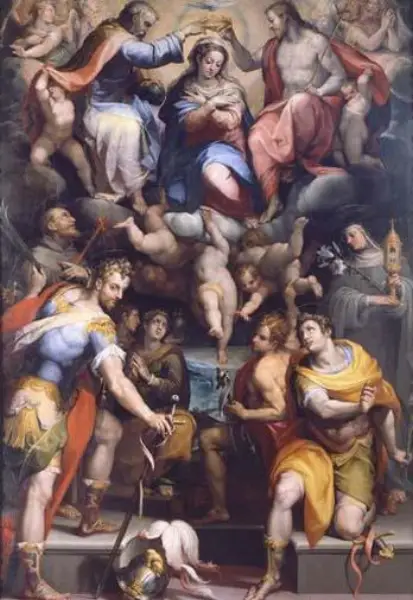
Overview
Nabor and Felix were Christian martyrs of the Great Persecution, remembered together since antiquity and honored especially in Milan. The apocryphal Acts of Saints Nabor and Felix, composed on the pattern of other martyr acts, present them as Roman soldiers from Mauretania Caesariensis in North Africa, in the region of modern Algeria, serving in the army of Maximian in the third century. As Christians they fell under the persecution launched by the emperor Diocletian, were condemned in Milan, and were executed by beheading at Laus Pompeia, today's Lodi Vecchio, around the year 303. A tomb in Milan has long been believed to hold their relics. Their cult took firm root in the city: in the early fourth century their remains were translated, probably under Bishop Maternus, to a site just outside the walls, where the Basilica Naboriana rose over the new tomb and Saint Ambrose himself composed a hymn in their honor. The Roman Catholic Church inserts them in the Roman Martyrology under July 12, and they stood in the General Roman Calendar from before the twelfth century until the reform of 1969, which still permits their Mass on their feast day. Their relics rest today in the Basilica of Sant'Ambrogio in Milan, while a second share of them lies in Cologne Cathedral.
The Complete Life
Soldiers from Mauretania
Nabor and Felix entered history as soldiers, and their story begins on the southern shore of the Mediterranean. The apocryphal Acts that preserve their legend describe them as natives of Mauretania Caesariensis, the Roman province corresponding to the central coast of modern Algeria, born in the third century and enrolled in the Roman army, where they served under the emperor Maximian. The Acts are candidly conventional literature, imitating the form of other martyr narratives such as those of Saints Firmus and Rusticus, and their details must be read as devotion shaped into story rather than minutes of a tribunal. Yet the outline they preserve has the ring of a common reality in the late imperial army: provincial Africans serving far from home in the ranks, and among them Christians whose ultimate loyalty was not the emperor's. Whatever their precise origin, the two were remembered at Milan as a pair, joined so closely in life or death that the city's cult never separated them, and the church that first housed their remains took its very name, Basilica Naboriana, from the first of the two. A separate and probably unrelated tradition located martyrs of the same two names at Nicopolis in Lesser Armenia, where they were said to have suffered in the year 320 alongside Januarius and Marinus; scholars suspect this pair was either distinct or a fusing of the Milanese story with the local pair Januarius and Pelagia, whose own feast fell on July 11.
§ Legend
The Soldiers' Choice
The vocation of Nabor and Felix was decided, according to the tradition, at the collision point between two loyalties: the military oath they had sworn to Maximian and the faith they professed in Christ. The persecution that caught them was the Great Persecution launched by Diocletian, the last and most systematic Roman attempt to suppress Christianity, and it did not spare soldiers; army service, which the state watched closely, became one of the places where a Christian's refusal of idolatry was most dangerous. Brought to Milan, the two were tried and condemned in that city, but the sentence was carried out a short distance away, at Laus Pompeia, the town known today as Lodi Vecchio. There they were put to death by decapitation, around the year 303, the death of soldiers executed as soldiers and honored ever after with the palms that mark the martyr's victory. The account leaves them no speeches and no marvels, only the stark sequence of condemnation and beheading; the silence of the oldest tradition is part of its credibility. What the Milanese church knew was where they had fallen and what they had refused to save themselves, and on those two facts it built a cult that outlasted the empire that killed them, the barbarian sieges that troubled their city, and a thousand years of change.
§ Legend
Martyrdom and the First Tomb
The deaths of Nabor and Felix around the year 303 closed their story and opened the second life of their memory. They were buried in Milan, and a tomb in that city has been believed since antiquity to contain their relics. In the early fourth century, within living memory of the persecution, their remains were translated from the place of interment to a new site outside the city walls, a few hundred meters north of where the Basilica of Sant'Ambrogio stands today; the translation was probably the work of Maternus, the Bishop of Milan. Over the new tomb a church was built, the Basilica Naboriana, and Paulinus of Milan attests the church in the life of Saint Ambrose that he wrote. The shrine quickly became woven into the spiritual geography of the city: tradition tells how Savina of Milan breathed her last in prayer at the martyrs' tomb, a death her contemporaries must have read as a grace, and Ambrose himself, the greatest of Milan's bishops, wrote a hymn in their honor. The martyrs who had been executed outside the walls as enemies of the empire ended as the permanent neighbors of the city that had condemned them, their church standing in the suburban ring of shrines that ringed Christian Milan.
§ Veneration
July 12 in the Martyrology
The Roman Catholic Church recognizes Nabor and Felix among its martyr saints, entering them in the Roman Martyrology, the official catalogue of the church's saints, under the date of July 12. Their cult was old enough to stand in the General Roman Calendar from before the twelfth century, a fixed point in the universal liturgical year. There it remained until the modern reforms of the calendar began to prune it of saints whose historical details had grown uncertain. When Saint John Gualbert was added to the calendar in 1595, sharing the same date, the feast of Nabor and Felix was reduced to a commemoration within his Mass, the first sign of their gradual displacement from the universal calendar. The revision of 1969 removed their names from the General Roman Calendar altogether, but the same reform preserved their cult in a significant way: the rules of the Roman Missal published that year permit their Mass to be offered on their feast day anywhere, except where an obligatory celebration falls on that date. The two Africans thus retain, more than seventeen centuries after their deaths, a Mass of their own that any priest in the world may offer on July 12, a quiet but universal recognition of a martyrdom the church has never doubted.
§ Feast day
From Milan to Cologne and the Pacific
The relics of Nabor and Felix led restless lives of their own. In 1258 they were moved to the new church of Saint Francis of Assisi, erected on the site of the old Basilica Naboriana, and when that church was itself demolished, their remains were translated between April 14 and 16, 1798, to the Basilica of Sant'Ambrogio, where they rest today within an ancient sarcophagus in the right-hand nave, placed alongside the relics of Saint Maternus and Saint Valeria. Milan had already shared them with the north: in 1158, when Emperor Frederick Barbarossa captured the city, he handed some relics of the two martyrs to Rainald of Dassel, Archbishop of Cologne, who brought them to his see, where they remain in a chapel of Cologne Cathedral. Nicholas of Verdun gave them a place of honor on the 1181 Shrine of the Three Kings, so that the Moorish soldiers of Diocletian stand in gold beside the Magi in the greatest reliquary of the German Middle Ages. Their fame even crossed the ocean: the Desventuradas Islands off Chile, sighted by Juan Fernández in 1574, were named by Pedro Sarmiento de Gamboa in 1579 after Saint Felix and Saint Ambor, that is Nabor, a name later corrupted by confusion with the more famous Saint Ambrose.
§ Veneration
Timeline
- 303
Condemned in Milan as Christians during the Great Persecution and beheaded at Laus Pompeia under Diocletian.
§ Legend
- 320
A pair named Nabor and Felix was said to have been martyred at Nicopolis in Lesser Armenia, alongside Januarius and Marinus.
§ Legend
- 1158
Emperor Frederick Barbarossa, after capturing Milan, gave some of their relics to Rainald of Dassel, who carried them to Cologne.
§ Veneration
- 1181
Nicholas of Verdun depicted Nabor and Felix on the Shrine of the Three Kings in Cologne Cathedral.
§ Veneration
- 1258
Their relics were moved to the new church of Saint Francis of Assisi, built where the Basilica Naboriana had stood.
§ Veneration
- 14 Apr 1798
Their relics were carried to the Basilica of Sant'Ambrogio just before the church of Saint Francis of Assisi was torn down.
§ Veneration
In Their Own Words
they are now called after St Felix and St Ambor (i.e. Felix and Nabor)
The Record
- Symbols
- Two young men in military attire·Palms
- Canonization
- Pre-congregation; recognized among the martyr saints in the Roman Martyrology under July 12.
Prayer
Bibliography
Show 7 sources
- Herbermann, Charles, ed. (1911). "Sts. Nabor and Felix". Catholic Encyclopedia. Vol. 10. New York: Robert Appleton Company.
- Bunson, Matthew; et al. (2003), Our Sunday Visitor's Encyclopedia of Saints, Rev. ed., Huntington: Our Sunday Visitor, p. 425, ISBN 1-931709-75-0.
- Giorgi, Rosa, "Saints: A Year in Faith and Art" (Harry N. Abrams, Inc., 2006).
- "Martyrologium Romanum" (Libreria Vaticana 2001, ISBN 88-209-7210-7).
- "Calendarium Romanum" (Libreria Editrice Vaticana, 1969), p. 129.
- Pasini, Cesare (1990). "Materno di Milano, santo (sec. IV)". Dizionario della Chiesa Ambrosiana. Vol. 4. Milano: NED. pp. 2112–2114. ISBN 88-7023-102-X.
- Corney, B. Glanvill, "The Isles of San Felix and San Nabor," The Geographical Journal, Vol. 56, No. 3 (September 1920), pp. 196-200.
Profile text adapted from the Wikipedia article, licensed CC BY-SA 4.0.
Pray with this saint every day
Save Sts. Nabor and Felix to your favorites, read the full profile, and get feast-day reminders in the Saints app.
Get the Saints AppFree on the App Store for iPhone and iPad