
died c. late 1st century·Feast May 12
Sts. Nereus and Achilleus
Roman soldiers converted to Christ and martyred
Overview
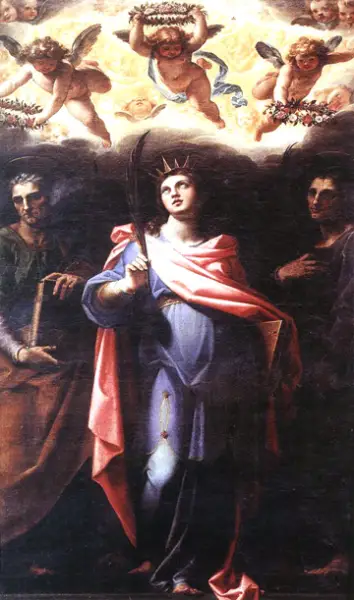
Nereus and Achilleus were two Roman martyrs whose names appear in the oldest registers of the Roman Church. An inscription composed by Pope Damasus and recovered from the basilica raised over their grave records that the two served as soldiers, obeyed a tyrant, then converted suddenly to Christianity, gave up their military commission gladly, and died for the faith. Their burial place lay in the Catacomb of Domitilla on the Via Ardeatina, where a three-naved basilica of the late fourth century was erected above their tomb; it was abandoned in the mid ninth century and rediscovered in 1874. Sculptured pillars from its ciborium depict their death by beheading, and a carved pillar preserves the name of Achilleus. Later legend made them chamberlains of Flavia Domitilla, banished with her to the island of Ponza and beheaded at Terracina, though these acts are acknowledged as without historical value. In the sixth century their relics were translated to the church of Ss. Nereo e Achilleo near the Baths of Caracalla, where they remain with those of Domitilla. Their joint memorial is kept on 12 May.
The Complete Life
Soldiers Who Laid Down Their Arms
The oldest historical witness to Nereus and Achilleus is the epigraph composed by Pope Damasus for the basilica built over their grave on the Via Ardeatina, a text also preserved in Medieval manuscripts. In verses well known to antiquity, Damasus relates that the two men served as soldiers in obedience to a tyrant, then were suddenly converted to Christianity, joyfully resigned their military commission, and joyfully accepted the martyr's death. That brief testimony carries the weight of the fourth-century Roman Church and has shaped every account of the pair since. Their names already stand in the old Roman lists of the fifth century, which passed into the Martyrologium Hieronymianum, recording that the brothers were buried in the cemetery on the Via Ardeatina; a votive Mass was celebrated at their grave each 12 May from the fourth century onward, and the seventh-century itineraries of the Roman pilgrims are unanimous in pointing to their resting place. Whatever else may be uncertain about their story, the Roman Church of the earliest centuries knew precisely who they were and where they lay.
§ Nereus and Achilleus
The Legend of the Chamberlains
Later tradition clothed the martyrs in a fuller narrative. The acts of Nereus and Achilleus, written in Greek and in Latin and admitted on all sides to be legendary even to the point of romance, make them eunuchs and chamberlains in the household of Flavia Domitilla, a niece of the emperor Domitian. According to this story the two men, together with their Christian mistress, were banished to the island of Ponza and afterwards beheaded at Terracina. The same acts draw no fewer than thirteen other Roman martyrs into their orbit, among them even Simon Magus through the apocryphal Petrine Acts, and they date the martyrdom to the end of the first century or the beginning of the second. Scholars judge these documents devoid of historical value for the saints' lives and deaths, and the Greek text is thought to be the original, rendered into Latin in the sixth century. Yet the legend agrees with the hard evidence in one essential respect: two servants of Christ died for him at Rome, close in place and spirit to the Flavian family from which Domitilla, foundress of the catacomb, herself came.
§ Legend
Twelve May at Rome
The liturgical commemoration of Nereus and Achilleus is among the most documented in the Roman calendar. The Tridentine calendar kept 12 May as a semidouble feast of Nereus, Achilleus, and Pancras, and the name of Domitilla was joined to the group in 1595. That fourfold celebration kept its rank in the calendar as it stood in 1954, was lowered to a simple feast under Pope Pius XII, and became a third-class feast in the revision of 1960. The reform of 1969 finally gave the saints their present form: Nereus and Achilleus together receive an optional memorial on 12 May, celebrated distinctly from Pancras, whose memorial falls on the same day, while Domitilla was set aside because her liturgical honors were judged to have no basis in tradition. The pairing of the two martyrs on a single feast, unchanged in essence for well over a millennium and a half, testifies to the manner in which the Roman Church has always remembered them, as brothers in service and in death whose witness is inseparable.
§ Feast day
The Basilica on the Via Ardeatina
The physical remains of the cult of Nereus and Achilleus form one of the great chapters of Roman Christian archaeology. A three-naved basilica of the latter part of the fourth century rose directly above their burial site in the Catacomb of Domitilla, near the grave of Petronilla; it was abandoned in the mid ninth century when the saints' relics were translated to the church of Ss. Nereo e Achilleo near the Baths of Caracalla, where they have rested with those of Domitilla under the high altar since the sixth century. In 1874 Giovanni Battista de Rossi rediscovered the ruined basilica. Among the finds were two pillars that had supported the ciborium, carved with scenes of the saints' beheading; one pillar survives intact with the name of Achilleus cut into it, and a large fragment of a marble slab bears the inscription of Pope Damasus. These stones constitute the oldest historical mention of the two martyrs and have made their grave on the Via Ardeatina a fixed point in the topography of early Roman Christianity.
§ Nereus and Achilleus
Timeline
- 1595
The name of Domitilla was added to the joint Roman feast of Nereus, Achilleus, and Pancras.
§ Feast day
- 1874
Giovanni Battista de Rossi rediscovered the ruined basilica over the saints' grave in the Catacomb of Domitilla.
§ Nereus and Achilleus
- 1960
The joint feast of Nereus, Achilleus, Domitilla, and Pancras was reduced to a third-class feast in the calendar revision of Pope John XXIII.
§ Feast day
- 1969
The revised General Roman Calendar assigned Nereus and Achilleus a distinct optional memorial on 12 May.
§ Feast day
In Their Own Words
IIII id. Maii, Romae in coemeterio Praetextati natale Nerei et Achillei fratrum (On 12 May at Rome in the cemetery of Praetextatus the natal day of the brothers Nereus and Achilleus)
The Record
- Canonization
- Pre-congregation martyrs venerated by the Roman Church since antiquity
Prayer
Bibliography
Show 7 sources
- Calendarium Romanum (Libreria Editrice Vaticana), p. 123.
- Orazio Marucchi, Monumenti del Cimitero di Domitilla sulla Via ardeatina, Parte 2, Editori Libreria Spithoever, 1914.
- Acta Sanctorum Maii, III, Paris 1866, pp. 10-11.
- Ferrari-Bravo, Anna, ed. (2007), "Catacombe di Domitilla", Guida d'Italia - Roma (in Italian), Milan: Mondadori, pp. 817-818.
- Weyman, "Vier Epigramme des h. Papstes Damasus", Munich, 1905; de Rossi, "Inscriptiones christianae", II, 31; Ihm, "Damasi epigrammata", Leipzig, 1895, 12, no. 8.
- Damasus Inscription at Ancient Basilica of Nereus and Achilleus.
- Seasoltz, R. Kevin (1966). The new liturgy: a documentation, 1903-1965. New York: Herder and Herder. p. 386.
Profile text adapted from the Wikipedia article, licensed CC BY-SA 4.0.
Pray with this saint every day
Save Sts. Nereus and Achilleus to your favorites, read the full profile, and get feast-day reminders in the Saints app.
Get the Saints AppFree on the App Store for iPhone and iPad