
died c. 851·Feast October 22
Sts. Nunilo and Alodia
Child Martyrs of Huesca under Islam
Overview
Nunilo and Alodia were two sisters from Huesca in north-eastern Spain, put to death for their Christian faith in the middle of the ninth century. Born into a prosperous family of mixed religion, with a Muslim father and a Christian mother, they were allowed to grow up in the faith of their mother. After their father's death their mother married again, taking a prominent Muslim who proved far less tolerant: he forbade the girls to attend church and pressed them to marry and embrace Islam. The sisters refused, and were placed with a Christian aunt in Castile. In 851 the emir Abd ar-Rahman II decreed that the children of Muslim fathers must adopt Islam on pain of death. Every attempt to make the girls apostatize failed. They were imprisoned in solitary confinement, pressed by women chosen to corrupt their way of life and by suitors urging marriage, and at last beheaded in Huesca, traditionally on 22 October 851. Their passion was recorded in the same year by Eulogius of Córdoba in his Memoriale Sanctorum, and their names passed into the Roman Martyrology and the calendars of the Mozarabic rite. Some scholars have questioned the traditional chronology, but the circumstances of their lives are judged consistent with what is known of religiously mixed families under early Islamic rule. Their relics rest today in the church of San Ginés in Arrecife, after long centuries at the Monastery of Leyre.
The Complete Life
Daughters of a Divided House
Nunilo and Alodia grew up in Huesca, a city in north-eastern Spain, in a household marked by the religious pluralism of the early Islamic period. Their father was a Muslim, their mother a Christian, and the family was prosperous. Unusually for such a household, the father permitted his daughters to be brought up in their mother's faith, and the sisters received the Christian formation that would define the rest of their short lives. The balance of the family changed with the father's death. Their mother married a second time, taking as her husband another prominent Muslim, a man of a far harsher temper who had no patience with the Christianity of his stepdaughters. He forbade the girls to go to church and demanded that they take husbands and embrace Islam. The sisters would not comply. To shield them from his authority, their mother sent them to live with a Christian aunt in Castile, and there the girls continued in the faith they had first learned from her. Their story has survived as one of the clearest pictures of how religiously mixed families functioned, and sometimes fractured, in the generations after the Muslim conquest of the Iberian Peninsula.
§ Nunilo and Alodia
A Faith Kept Against the Household
In the household of their aunt in Castile, beyond the reach of the stepfather who had forbidden their worship, Nunilo and Alodia settled into the Christian life their mother had given them. Little is recorded of these years beyond the fact of their perseverance in that faith, yet the choice it implied was real and costly. They were daughters of a Muslim father at a time when the society of al-Andalus expected the children of Muslim fathers to be Muslim. Their mother's first husband had allowed an exception; his successor refused to tolerate one. The sisters, still young — later tradition remembers them among the child martyrs — had already accepted that their Christianity might cost them family, inheritance, and marriage, the ordinary futures open to girls of a rich house. When the crisis came they had no new decision to make; the faith they refused to surrender was one they had knowingly kept through years of domestic opposition. Eulogius of Córdoba, who preserved their story, saw in such households the quiet drama of ninth-century Spain: mothers of one religion, fathers of another, and children who at some point had to choose. The sisters chose the Church, and they never withdrew the choice.
§ Nunilo and Alodia
The Decree of 851
In 851 the emir Abd ar-Rahman II issued a decree aimed at the children of mixed marriages: every Christian child of a Muslim father was to accept the religion of the father or face execution. The decree reached the two sisters at Huesca. Repeated attempts were made, and failed, to persuade Nunilo and Alodia to agree to conversion, and their refusal placed them under arrest. They were put in solitary confinement, cut off from the supports of family and church, while their captors tried softer instruments. The authorities handed the girls over to women of dubious morality, hoping that corrupted company would change their way of life, and suitors pressed them with offers of marriage, which they could have accepted only at the price of their faith. Both stratagems failed. Whatever else the decree of 851 accomplished, at Huesca it produced two prisoners who could not be argued, flattered, or shamed out of a religion they had kept against their own household. Their persistence turned a domestic dispute into a public witness: the trial of the two sisters became one of the recorded cases of Christians under Abd ar-Rahman II, remembered chiefly through the account written by Eulogius of Córdoba.
§ Nunilo and Alodia
Constancy under Persuasion
The spiritual profile of Nunilo and Alodia is drawn entirely from the ordeal the sources record, and it is an austere one. Their constancy was tested not by torture, as far as the account goes, but by isolation and temptation: confinement alone, corrupting companions, and the persistent lure of marriage, which offered survival, status, and reconciliation with their family. The sisters declined each in turn. Their resistance bore no mark of pride or resentment; the sources present them as quiet and immovable, keeping the faith received from their mother precisely where it was socially weakest, in the persons of two orphaned girls of a mixed house. Their virginity, which their persecutors hoped to end by seduction or by marriage, became in the tradition the sign of an undivided heart, and the calendars that remember them rank them among the virgin martyrs. Modern readers who have studied the martyr movement of ninth-century Córdoba have noted that stories like theirs preserve the texture of daily religious negotiation inside mixed families: faith worked out at table, in marriage negotiations, and in the raising of children. In that setting the endurance of the two sisters, under confinement and persuasion rather than the sword, was itself their confession of Christ.
§ Nunilo and Alodia
Martyrdom and the Question of Dates
The end came at Huesca on 22 October 851, the date the tradition has generally kept for the beheading of the two sisters. Eulogius of Córdoba, writing in that same year, recorded their martyrdom in his Memoriale Sanctorum, and from his account the date passed into the Roman Martyrology and the liturgical books of the Mozarabic rite. The record is not without difficulties. Scholars have long questioned the chronology Eulogius gives for the martyrs of the 850s, and the historian Ann Rosemary Christys has argued for a much earlier death, perhaps about 813, though the evidence remains inconclusive. A further complication lies in the Acta Sanctorum, which assigns the year 880 to the translation of their relics; this figure may come from a mistaken reading of the Hispanic era as Anno Domini dating, which would set the translation in 842 and the martyrdom itself near 813. Whatever the precise year, the fact of their death by beheading, in the city of their birth and for refusing Islam, has never been doubted, and it is this fact that the Church has celebrated on 22 October ever since.
§ Nunilo and Alodia
Recognized by Their Blood
Nunilo and Alodia were never canonized in the modern manner; they belong to the company of martyrs whose cult the Church acknowledged from the circumstances of their death. Their passio entered written memory almost immediately through the Memoriale Sanctorum which Eulogius of Córdoba completed in 851, and by that channel their names reached the Roman Martyrology and the calendars of the Mozarabic rite, where they remain. In the eleventh century the sisters received a fuller treatment in the Passional of Cardeña, one of the chief collections on the Hispanic martyrs, according to the art historian Julie Harris. The Bollandists later printed the record of their translation in the Acta Sanctorum for 22 October. Modern scholarship has handled their story with careful respect: Christian C. Sahner has judged some details dubious, yet grants that the sisters' situation fits the inner dynamics of mixed families as historians understand them. No decree of any pope was needed. The Christians of the Ebro valley mourned the sisters as martyrs from the first, and the Church's annual memorial on 22 October is the continuation of that earliest judgment.
§ Nunilo and Alodia
The Casket at Leyre
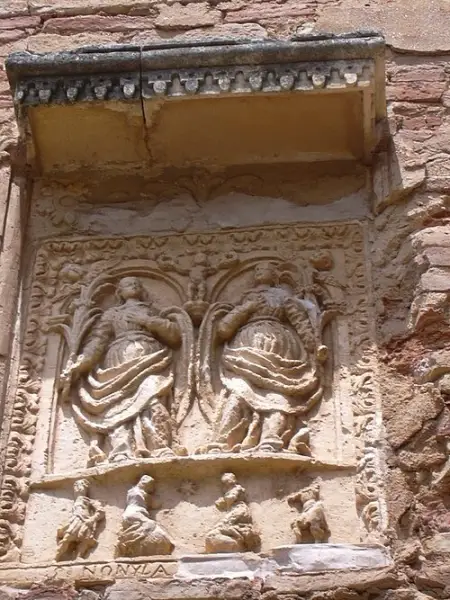
The longest afterlife of the two sisters belongs to the Monastery of Leyre in Navarre. Their relics were translated there during the ninth century, and the great ivory casket made in Córdoba in 1005, known ever since as the Leyre Casket, was in time brought to the monastery and repurposed as their reliquary — a Muslim work of art placed at the service of two martyrs put to death for refusing Islam. Julie Harris has suggested that the casket was turned to Christian use when the monastery's crypt was consecrated in 1057. Carvings of the sisters survive on the collegiate church of Alquézar, where Nunilo's name is still legible on the base of the figure while her sister's has broken away, and a statue at the monastery of San Salvador de Leyre shows them on the way to martyrdom. After the monastery's suppression in 1836 the relics passed to the church of San Ginés in Arrecife, where they remain. Historians continue to return to the sisters as witnesses to the mixed society of early Islamic Spain, for the account of their family remains a key source on how Christian-Muslim households lived, quarreled, and died in the ninth century.
§ Nunilo and Alodia
Timeline
- 22 Oct 851
Beheaded at Huesca for refusing to convert to Islam, under the decree of Abd ar-Rahman II.
§ Nunilo and Alodia
- 851
Their martyrdom is recorded by Eulogius of Córdoba in the Memoriale Sanctorum.
§ Nunilo and Alodia
- 880
Their relics are translated to the Monastery of Leyre in Navarre, according to the Acta Sanctorum.
§ Nunilo and Alodia
- 1005
The ivory Leyre Casket, later used as their reliquary, is produced in the Caliphate of Córdoba.
§ Nunilo and Alodia
- 1057
The crypt of the Monastery of Leyre is consecrated; the casket may have become their reliquary about this time.
§ Nunilo and Alodia
- 1836
The Monastery of Leyre is suppressed, and the relics are moved to San Ginés Church in Arrecife.
§ Nunilo and Alodia
The Record
- Canonization
- Pre-congregation martyrs; their cult was recognized from the circumstances of their death and their names entered the Roman Martyrology
Prayer
Bibliography
Show 7 sources
- Bolognini, Daniele (12 September 2012). "Sante Nunilone e Alodia". Santie Beati (in Italian). Retrieved 6 December 2024.
- Collins, Roger (1987). The Basques. New York: Basil Blackwell. p. 51. ISBN 978-0-631-13478-7.
- Harris, Julie (June 1995). "Muslim Ivories in Christian Hands: The Leire Casket in Context". Art History. 18 (2): 215.
- Baring-Gould, Sabine (1877). The Lives of the Saints. Vol. 12. London: J. Hodges. p. 575.
- Sahner, Christian C. (2018). Christian Martyrs under Islam: Religious Violence and the Making of the Muslim World. Princeton, New Jersey: Princeton University Press. ISBN 9780691179100.
- Christys, Ann Rosemary (2002). Christians in al-Andalus, 711–1000. Culture and Civilization in the Middle East. London and New York: Routledge. pp. 73–74. ISBN 978-0-7007-1564-0.
- Acta Sanctorum Octobris, Tomus IX (in Latin). Paris: Societe des Bollandistes. 1859. pp. 645–646. Die vigesima secunda Octobris: Translatio Sanctorum Virginum et Martyrum Christi Nunilonis et Alodiae.
Profile text adapted from the Wikipedia article, licensed CC BY-SA 4.0.
Pray with this saint every day
Save Sts. Nunilo and Alodia to your favorites, read the full profile, and get feast-day reminders in the Saints app.
Get the Saints AppFree on the App Store for iPhone and iPad