
died 302·Feast October 8
Sts. Palatias and Laurentia
Martyred mistress and servant of Fermo
Overview
Saints Palatias and Laurentia are honored as martyrs both by the Catholic West and by the Orthodox East. What tradition preserves of them relates that Palatias, remembered also as Palatia, was an aristocratic Roman woman brought to the Christian faith by Laurentia, who was her wet nurse or, in other accounts, her slave. The two women were put to death for their faith at Fermo, in the present-day Italian region of Marche, in 302, during the persecution ordered by the emperor Diocletian. The story of their passion survives in an ancient manuscript from Ancona whose date cannot be fixed, together with another witness preserved by the Biblioteca Vallicelliana in Rome, and the narratives include legendary elements drawn from the lives of other virgin martyrs such as Christina, Barbara, and Victoria. The scholar Mario Natalucci judged it possible that the pair were in fact natives of Ancona, killed in the Diocletianic persecutions and carried as relics to that city. Their cult spread through the Piceno, and Ancona's ancient liturgical books record the name Palazia, and likenesses of her in stone are attested from the eleventh century onward.
The Complete Life
A Noblewoman and Her Nurse
The tradition surrounding the two saints begins in the world of Roman high society. Palatias, whose name appears in Italian as Palazia and in the feminine form Palatia, is described as a woman of aristocratic birth, a member of the Roman governing class that inhabited the villas and townhouses of the empire's oldest families. Into her household came Laurentia, remembered variously as her wet nurse or as her slave, a woman of the lowest legal condition in the Roman order. Yet it was the servant who possessed the treasure, for Laurentia was a Christian and shared her faith with the child she had nursed or the mistress she served, and by her word Palatias was converted to Christ. Their story thus reverses every expectation of rank: the dependent converts the noble, the slave becomes the spiritual mother of a patrician. The scholar Mario Natalucci has proposed another reading of their origins, suggesting that the two may have been natives of Ancona itself, put to death in the persecutions of Diocletian and afterward honored in that city as their relics were gathered there. Whatever their true home, the church has never ceased to remember them as inseparable companions in martyrdom.
§ Introduction
Martyrdom at Fermo
In the year 302 Diocletian set in motion the severest assault the ancient empire ever mounted against Christianity, and the two women of this account were caught in its machinery. According to their tradition, they were arrested as Christians and put to death at Fermo, the hilltop city of Picenum that stands a short distance inland from Ancona, in the region now known as Marche. Nothing is recorded of the manner of their execution or of their last words; the silence of the sources is itself a reminder of how many Passion narratives of that era preserve only the bare fact of witness and death. What can be said is that the memory of their sacrifice took root in the soil where it happened. Their veneration spread across the Piceno, the ancient coastal territory of northeastern Italy, and endured at Fermo, Osimo, and Camerino through the centuries. Ancona claimed a special bond with them, for there the name of Palazia entered the ancient liturgical books of the city, and images of the martyr began to be carved and set up from the eleventh century onward.
§ Introduction
Relic, Church, and Canvas
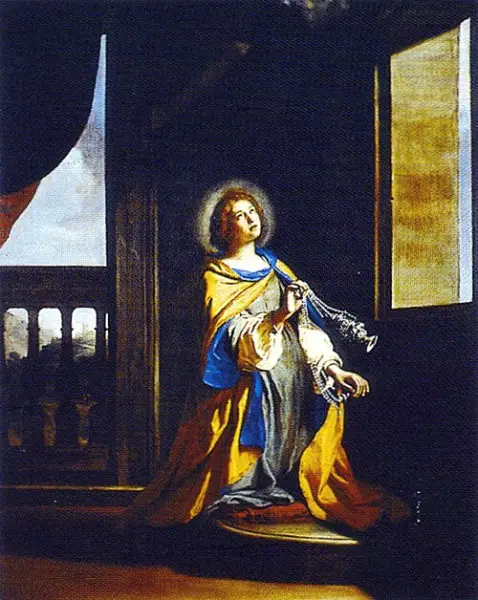
The account of the two martyrs reached posterity through fragile channels. An ancient manuscript of uncertain date preserved at Ancona transmits the story of their lives and passion, and a second witness was kept in the collection of the Biblioteca Vallicelliana at Rome. Scholars caution that the narratives contain legendary material, employing the familiar themes found in the vitae of other virgin saints such as Christina, Barbara, and Victoria; the two women belong to that great family of early martyrs whose histories were told in the language of devotion as much as documentation. Their cult, however, needed no scholarly endorsement to flourish. A church and monastery rose in their honor, and their relics were eventually gathered into a single small bronze urn in the Berninian manner, which Pope Benedict XIV, who had once served as bishop of Ancona, bestowed upon the cathedral of that city, where they remain the focus of veneration. The martyr has also found her place in art: Guercino's painting of Saint Palazia is preserved today in the Pinacoteca Civica Francesco Podesti in Ancona, and the two saints keep their feast together on October 8.
§ Introduction
Timeline
- 302
Executed for their Christian faith at Fermo, near Ancona, during the persecution of Diocletian.
§ Introduction
- 1000
Statues of Palatias begin to appear at Ancona, where her name is already found in ancient liturgical texts.
§ Introduction
The Record
- Canonization
- Pre-congregation canonization; venerated as a martyr since the earliest centuries of the Church.
Prayer
Bibliography
Show 2 sources
- "St. Palatias and Laurentia". Catholic Online (in Italian).
- Natalucci, Mario. "Sante Palazia e Laurenzia Martiri".
Profile text adapted from the Wikipedia article, licensed CC BY-SA 4.0.
Pray with this saint every day
Save Sts. Palatias and Laurentia to your favorites, read the full profile, and get feast-day reminders in the Saints app.
Get the Saints AppFree on the App Store for iPhone and iPad