
died c. 257-259·Feast September 11 (Roman Catholic Church); December 24 (Byzantine Catholic and Eastern Orthodox Churches)
Sts. Protus and Hyacinth
Martyred brothers of the Valerian persecution in Rome
Overview
Protus and Hyacinth were Christian martyrs put to death in Rome during the persecution of Emperor Valerian, which ravaged the Roman church between 257 and 259. They were commemorated in Rome by 11 September, a date already fixed in the Depositio Martyrum recorded in the Chronograph of 354, one of the oldest martyrologies of the Roman church. A later Passion, composed in Latin in Italy between 450 and 499, recounts that the two served as eunuch chamberlains to Saint Eugenia of Rome, were baptized with her by Helenus, bishop of Heliopolis, devoted themselves to the study of scripture among the hermits of Egypt, and followed Eugenia to Rome, where they were arrested for their faith and beheaded after scourging on 11 September 258. Modern scholars regard that Passion as a novelistic construction, but the antiquity of the two martyrs' cult is beyond doubt. Pope Damasus I honored them with an epitaph, part of which survives, calling them brothers. They were buried together in the cemetery of Basilla on the Via Salaria, and the recovery of their graves in modern times confirmed the ancient testimony.
The Complete Life
Servants of a Noble Convert
The only narrative of the two martyrs' lives comes from a Passion composed in Latin in Italy between 450 and 499, some two centuries after their deaths, and its account must be read with the caution its novelistic character demands. According to that text, Protus and Hyacinth served as eunuch chamberlains in the household of Eugenia, a Roman matron of the highest rank who had secretly embraced Christianity. When Eugenia's faith was revealed, the two chamberlains received baptism alongside her at the hands of Helenus, bishop of Heliopolis. Far from remaining mere domestic attendants, they applied themselves with zeal to the study of sacred scripture, and they shared the austere life of the hermits of Egypt, the first monks of the desert, before returning with Eugenia to the capital. Whatever weight the story will bear historically, it portrays the two men from the beginning as more than servants: companions in conversion, students of the Word, and practitioners of the ascetic life, whose fidelity in a Christian household prepared them for the greater fidelity of the arena. The tale binds the two men to one another long before their deaths, so that the bond Pope Damasus would later honor on their epitaph is presented not as an accident of martyrdom but as the fruit of years of shared service.
§ Tradition
Arrest and Martyrdom
The Passion places the arrest of Protus and Hyacinth in Rome during the imperial persecution of Christians, and the year of their deaths is fixed by the oldest Roman records in the reign of Valerian, whose edicts against the church between 257 and 259 produced the first mass persecution of the Roman clergy and laity. Summoned before the authorities, the two men refused to deny their faith. The sentence was carried out in stages, following the grim ritual of Roman penal law: they were first scourged and then beheaded, the swifter death reserved for citizens and favored victims. The Passion gives the date as 11 September 258. Whether or not the details of the narrative survive from contemporary memory, the fact of their martyrdom and the date of its commemoration are corroborated independently by the Depositio Martyrum preserved in the Chronograph of 354, which lists their annual observance on that very day, less than a century after the events. Two household servants thus joined the ranks of the Roman church's earliest recorded martyrs. The persecution in which they died was long remembered as among the fiercest Rome ever waged, and the church of the city counted the confessors of those years among the surest of its witnesses.
§ Introduction
Burial Beneath the Via Salaria
The Chronograph of 354 records that the two martyrs were buried side by side in the cemetery of Basilla along the Via Salaria that later took the name of the Catacomb of Sant'Ermete, and the early itineraries and other ancient authorities confirm this as their resting place. Their grave became a site of pilgrimage, but time and depredation took their toll. When Pope Leo IV transferred the bones of many Roman martyrs into the city's churches in the mid-ninth century, the relics of the two saints were to be moved as well; yet the burial chamber had been so devastated that only the grave of Protus was found, and his remains alone were translated to the church of San Salvatore on the Palatine Hill. Hyacinth lay undisturbed and forgotten until 1845, when Father Giuseppe Marchi discovered his grave in a crypt of the same catacomb: a small square niche holding ashes and fragments of burned bone, wrapped in the remains of costly fabrics, and closed by a marble slab bearing its original Latin inscription, which confirmed the burial date preserved in the old Roman Martyrology. Few martyrs of the third century can claim documentation so continuous, reaching from the compilers of the Chronograph to the excavators of the nineteenth century.
§ Graves
An Ancient and Verified Cult
The cult of Protus and Hyacinth belongs to the earliest stratum of Roman martyr veneration. Their commemoration appears in the Depositio Martyrum of 354, and Pope Damasus I, the great restorer of the martyrs' tombs in the late fourth century, composed an epitaph in their honor, a portion of which still exists; in it he calls the two men brothers, the earliest testimony to the bond later tradition assumed between them. Their feast is kept on 11 September in the Roman Catholic Church and on 24 December in the Byzantine Catholic and Eastern Orthodox Churches, and they are venerated across the Catholic, Coptic Orthodox, and Eastern Orthodox traditions. The modern discoveries gave their ancient cult an unusual archaeological seal: Marchi's excavation of 1845 brought to light not only the inscription naming Hyacinth as martyr buried on 11 September, but also fragments of an architrave reading 'grave of the martyr Protus' in the same chamber, proving that both had originally been laid in one crypt, exactly as the fourth-century records declared. In Ravenna and in Cornwall, in Roman archives and in a Cornish village name, the two chamberlains of the Via Salaria remain witnesses to the age that made the Roman church.
§ Graves
Shrines in Rome and a Church in Cornwall
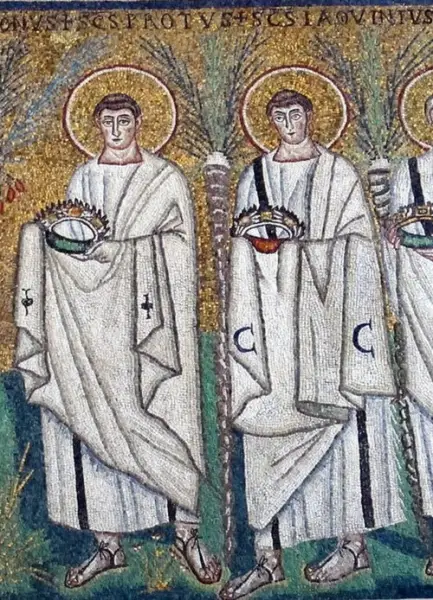
The memory of the two martyrs endures in places far removed from their cemetery on the Via Salaria. In Rome, their veneration is attached to the church of San Giovanni dei Fiorentini and to the chapel of the Propaganda College, where Hyacinth's remains were enthroned in June 1933 after their discovery in 1845; the two martyrs' tombs, together with a stairway dating from the close of the fourth century, have since been uncovered and restored, returning the site of their first burial to pilgrim view. Their cult also crossed the Channel in the middle ages: the parish church of Blisland in Cornwall was dedicated to Saint Protus and is known locally as St Pratt's, preserving the corrupted English form of the martyr's name that grew up in medieval England. A mosaic in the Basilica of Sant'Apollinare Nuovo in Ravenna portrays them among the procession of martyrs, shown as two young men bearing the crowns of their victory. Thus two chamberlains of the third-century persecution remain present in the art, architecture, and liturgy of both East and West. Theirs is a memory that archaeology, liturgy, and village devotion have preserved together.
§ Cult in England
Timeline
- 11 Sep 258
Beheaded in Rome, according to the later Passion, after being scourged for refusing to deny their faith during the Valerian persecution
§ Tradition
- 354
The Depositio Martyrum in the Chronograph of 354 records their annual commemoration on 11 September and their burial in the cemetery of Basilla on the Via Salaria
§ Introduction
- 450
The Passion of the Martyr Saints Protus and Hyacinth (BHL 2667), a novelistic Latin account linking them to Eugenia of Rome, was composed in Italy between 450 and 499
§ Tradition
- 847
During the reign of Pope Leo IV (847-855) the grave of Protus was found in the devastated burial chamber and his remains translated to San Salvatore on the Palatine Hill
§ Graves
- 1845
Father Giuseppe Marchi discovered the still undisturbed grave of Hyacinth in a crypt of the catacomb, with its original Latin inscription
§ Graves
- Jun 1933
The relics of Hyacinth were enthroned in the Roman chapel of the Propaganda College; afterward the burial places of both martyrs and a fourth-century stairway came to light and were restored
§ Graves
In Their Own Words
Buried on 11 September Hyacinthus Martyr
The Record
- Symbols
- Depicted as two young men holding the crowns of martyrdom
- Canonization
- Pre-congregation; honored as martyrs from the earliest Roman records, including the Depositio Martyrum of 354
Prayer
Bibliography
Show 6 sources
- Thierry Ruinart, "Acta martyrum", ed. Ratisbon, 632.
- Ihm, "Damasi epigrammata", 52, 49.
- Mike Salter (April 1999). The Old Parish Churches of Cornwall. Folly Publications. p. 12. ISBN 1871731372.
- De Rossi, "Roma sotterranea", I, 176-177.
- Marchi, "Monumenti primitivi: I, Architettura della Roma sotterranea cristiana", Rome, 1844, 238 sqq., 264 sqq.
- Herbermann, Charles, ed. (1913). "Sts. Protus and Hyacinth". Catholic Encyclopedia. New York: Robert Appleton Company.
Profile text adapted from the Wikipedia article, licensed CC BY-SA 4.0.
Pray with this saint every day
Save Sts. Protus and Hyacinth to your favorites, read the full profile, and get feast-day reminders in the Saints app.
Get the Saints AppFree on the App Store for iPhone and iPad