
2nd century AD·Feast 17 September
Sts. Faith, Hope and Charity
Virgin martyr daughters of St. Sophia of Rome
Overview
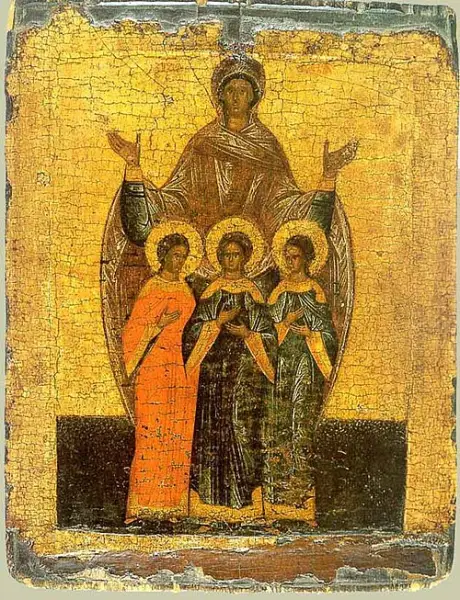
Faith, Hope and Charity (Latin: Fides, Spes et Caritas) are honored as a group of young virgin martyrs of the second century, venerated together with their mother, Sophia, whose name means Wisdom. The Passio recounts that Sophia, a widow of Milan, gave away her possessions and journeyed to Rome with her three daughters, whose names embody the three theological virtues. There each girl suffered martyrdom before her mother's eyes, and Sophia buried them along the Via Appia. Three days later, as she prayed at their tomb, she died a natural death herself and was laid beside them. References from the age of Gregory the Great speak of two groups of mother-and-daughter martyrs buried on the Aurelian Way and the Via Appia. Their tomb in a crypt beneath a church raised to Saint Pancratius drew pilgrims for centuries, as seventh-century documents such as the Salzburg Itinerarium and the Monza list of holy oils attest. Critical scholarship regards the hagiographical narrative as spurious, probably inspired by early Christian inscriptions bearing virtue names, and holds that their distinct veneration arose in the sixth century. Their cult reached the West beyond Rome when relics were carried to Eschau in Alsace in 778.
The Complete Life
A Widow of Milan and Her Three Daughters
The narrative of the Passion preserves little of the family's origins beyond a few telling details. Sophia was a widow of Milan, left alone with three daughters to whom she gave names that no Christian could mistake: Faith, Hope and Charity, the three theological virtues at the heart of baptismal life. Early Christians of the fourth century and later often took mystical names of this kind at baptism, and inscriptions from the Roman catacombs record Christian women called Sophia, Sapientia and Fides. In the story, when Sophia embraced widowhood she also embraced poverty, giving away her possessions entirely. Milan, a great imperial city of the Italian north, was left behind as she made the journey to Rome with her daughters, choosing the city of the apostles as the stage for their common consecration. Whatever the historical value of these details, the picture the tradition paints is coherent and moving: a household bound together by a mother's faith, carrying the names of virtues as a daily rule of life, and willing to surrender security, home and finally life itself in the capital of the empire. The account belongs to a family of legends whose oldest Latin version is catalogued as BHL 2966.
§ Saints Faith, Hope and Charity
Martyrdom Before Their Mother's Eyes
In Rome the story reaches its climax swiftly. Each of the three daughters was put to death for Christ, one after another, while their mother watched. The Passio does not linger over the mechanics of their trials; its power lies in the succession of losses that Sophia endured and in the girls' constancy. When the youngest suffering had been offered, their mother herself buried the three martyrs along the Via Appia, the ancient road lined with the tombs of Rome's Christian dead. Three days after her daughters, Sophia died as well, yet not by the sword: she died a natural death while praying at their grave, and the tradition honors her among the martyrs' companions rather than as a martyr herself. Alongside this literary account stand older Roman records. Documents from Gregory the Great's era speak of two separate mother-and-daughter groups of martyrs, laid to rest respectively along the Aurelian Way and the Via Appia — a hint that the legend may interweave the memories of more than one Roman family of confessors. The tomb in a crypt beneath a church later built to Saint Pancratius remained a resort of pilgrims long afterward.
§ Saints Faith, Hope and Charity
Virtues Given as Names
The deepest meaning of this trio of saints lies in their names. Faith, Hope and Charity are not incidental labels but the theological virtues themselves, borne by three sisters and crowned by a mother named Wisdom. Scholars have long noted that the veneration of saints named for the virtues probably arose in the sixth century from catacomb inscriptions in which ordinary Christian women bore names such as Sophia and Fides, given in baptism as mystical signs of the life of grace. Critical scholarship is unanimous in judging the hagiographical tradition spurious, likely inspired by those Latin inscriptions and by the concepts of Holy Wisdom, Faith, Hope and Charity. Yet the Church received the legend precisely because it preached: a mother who names her children after the virtues and then must offer each of them to God embodies the whole Christian life in a single domestic image. Sophia's own death, three days of prayer at her daughters' tomb and then a quiet end, presents grief transfigured by faith. Devotion to the group flourished in the East and West alike, and a fourteenth-century fresco of the mother and daughters still survives in the chapel of St. Agnes in Cologne Cathedral.
§ Saints Faith, Hope and Charity
The Grave by the Appian Way
The last days the tradition assigns to Sophia are not years but hours: three days between her daughters' burial and her own death. The Passio places her at the tomb on the Via Appia, praying where her children lay, and there she died peacefully. The place of their burial became the anchor of their cult. The grave lay in a crypt below the church later raised in honor of Saint Pancratius, and seventh-century writings record pilgrims continually arriving there. One witness is an Itinerarium — a pilgrim's manual to Rome's sacred sites that survives at Salzburg — another the Monza cathedral register of the oils collected at the martyrs' graves and dispatched to Queen Theodelinda in Gregory the Great's day. Devotion to the mother first surfaces in the late sixth century, within that same chrism register compiled for Theodelinda, the Lombards' ruler. As the medieval era went on, the traditions of Sophia of Milan and of Sophia of Rome merged into one, and relics belonging to one woman or the other reached the convent for women at Eschau in Alsace, planting her cult in German soil.
§ Saints Faith, Hope and Charity
Feast Days Gained and Lost
The liturgical history of the three sisters and their mother is unusually well documented for saints of such doubtful history. Earlier editions of the Roman Martyrology commemorated Faith, Hope and Charity on the first of August and Sophia on the thirtieth of September. It was Caesar Baronius who first introduced the group into the Roman Martyrology in the late sixteenth century, drawing on the ancient Passion and the Roman topographical tradition. The feast of August the first, however, was never entered in the General Roman Calendar, and the present text of the Martyrology, an official but professedly incomplete catalogue, leaves the three sisters and their mother without any feast; the sole Sophia retained there is an early virgin martyr of Picenum, remembered with Vissia on the twelfth of April. Other saints bearing the same virtue names hold separate days: a Saint Faith of Aquitania on the sixth of October, a Saint Hope, abbot of Nursia who died about 517, on the twenty-third of May. The Eastern Orthodox Church keeps their feast on the seventeenth of September, while the Armenian Apostolic Church keeps theirs on the Thursday following Transfiguration's third Sunday, shifted when required to respect the fast of the Assumption.
§ Saints Faith, Hope and Charity
From Roman Catacombs to Cologne and Eschau
Few martyr groups show so clearly how a devotion grows from inscription to empire-wide remembrance. The chain runs from baptismal names in the catacombs, through a sixth-century legend that gave the virtues faces and a mother, through the oils sent to a Lombard queen, to the pilgrimage crypt by the Appian Way. Beyond Rome, the relics carried to Eschau in 778 planted the cult in German lands, where it was kept at the church of St Trophimus at Eschau, where the relics remain venerated. Art carried the story further: a fourteenth-century fresco in the chapel of St. Agnes in Cologne Cathedral depicts the three sisters with their mother Sophia, testimony that the family legend spoke to late medieval devotion centuries after its supposed era. In the Armenian Church the commemoration found a fixed place in the movable cycle after the Transfiguration, with careful rubrics governing its transfer. Modern scholarship has demoted the narrative to legend, yet the saints keep their place in Eastern calendars and in popular piety, and Sophia endures as patroness of widows. The trio remains a classic case of virtues themselves honored under the forms of virgin martyrs.
§ Saints Faith, Hope and Charity
The Record
- Patron of
- patroness of widows (Sophia)
- Canonization
- Pre-congregation martyrs; Caesar Baronius introduced them to the Roman Martyrology in the late 16th century, though the present Roman Martyrology lists no feast for them
Prayer
Bibliography
Show 5 sources
- Murphy, John F. X. (1909). "Sts. Faith, Hope and Charity". The Catholic Encyclopedia. Vol. 5. New York: Robert Appleton Company.
- Ekkart Sauser (2000). "Fides, Spes und Charitas: hl. Märtyrerinnen". In Bautz, Traugott (ed.). Biographisch-Bibliographisches Kirchenlexikon (BBKL). Vol. 17. Herzberg: Bautz. col. 381. ISBN 3-88309-080-8.
- V. Saxer, "Sophia v. Rom" in: Lexikon für Theologie und Kirche vol. 9 (1993), 733f.
- "Martyrologium Romanum". Boston Catholic Journal. 2004.
- Domar: the calendrical and liturgical cycle of the Armenian Apostolic Orthodox Church, Armenian Orthodox Theological Research Institute, 2003, p. 359-60.
Profile text adapted from the Wikipedia article, licensed CC BY-SA 4.0.
Pray with this saint every day
Save Sts. Faith, Hope and Charity to your favorites, read the full profile, and get feast-day reminders in the Saints app.
Get the Saints AppFree on the App Store for iPhone and iPad