
died c. 304·Feast 4 November
Sts. Vitalis and Agricola
Protomartyrs of Bologna under Diocletian
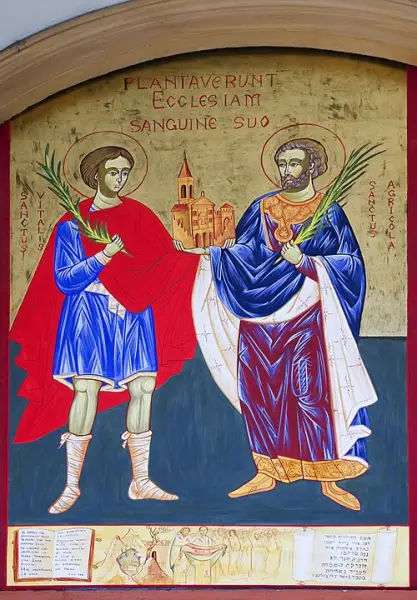
Overview
Vitalis and Agricola are honored as the protomartyrs of Bologna, put to death there around the year 304 in the persecution ordered by the emperor Diocletian. Agricola was a Christian citizen of the city who converted his slave Vitalis to the faith; master and servant became deeply attached to one another in Christ. When the persecution reached Bologna, Vitalis was the first to suffer, executed in the amphitheatre before the crowds. The authorities then turned on Agricola, subjecting him to tortures meant to break his resolve, but he would not give up his religion, and he was finally crucified. Almost a hundred years afterward, between 392 and 393, Bishop Eusebius of Bologna made public the finding of the two martyrs' remains in a Jewish cemetery of the city and gave them honorable Christian burial, with Ambrose of Milan there to witness it. Ambrose spread their cult across northern Italy, carrying relics to Milan and Florence and preaching on the martyrs in his oration in praise of virginity. A basilica rose at Bologna to house the remains, and the church of San Vitale ed Agricola in Arena is said to stand over the amphitheatre where Vitalis died and Agricola was crucified.
The Complete Life
A Master, a Slave, and One Faith
Agricola was a Christian citizen of Bologna, a man of some standing in a city on the Via Aemilia that had long been home to a Christian community. His household included a slave, Vitalis, and in that household the unlikely happened: the master converted the servant to Christianity, and the two became deeply attached to each other. In the Roman world the gulf between citizen and slave was nearly absolute, so the bond that formed between Agricola and Vitalis carried its own quiet witness before either man ever faced a magistrate. What the faith taught them was that both stood equal at the foot of the cross, and the tradition remembered them ever after as a pair, never separately. Their story is known only through the writings of Ambrose, and especially through his mention of the two martyrs in the first part of his oration in praise of virginity, De exhortatione virginitatis, delivered with particular attention to Juliana, a Roman matron, and her three virgin daughters. Everything else about their lives, ages, families and circumstances, has been lost; what survived was the memory of a master and a slave who died for the same Lord within days of each other in the Bologna of Diocletian's final persecution.
§ Legend
The Arena and the Cross
When Diocletian's persecution ordered the suppression of Christianity across the empire, it reached Bologna around the year 304, and the two believers were brought forward. Vitalis, the slave and the younger in the faith, was the first to suffer martyrdom, executed in the amphitheatre where condemned criminals were thrown to public spectacle. His death did not purchase his master's safety. The authorities laid hold of Agricola and subjected him to tortures designed to force him to give up his religion, but the tortures failed. Neither pain nor the example of his servant's death moved him to sacrifice, and the sentence that followed was one reserved for the lowest criminals and slaves: crucifixion. Thus master followed servant in death, each dying in the manner proper to his station in Roman law yet equal in the Church's memory. Tradition even preserves the setting: Bologna's church of San Vitale ed Agricola in Arena is said to occupy the footings of the very amphitheatre where the two were put to death in the fourth century. Bologna, which had no earlier martyrs of its own to remember, reckoned these two as its first, its protomartyrs.
§ Legend
Relics Found in a Jewish Cemetery
The martyrs' formal cult begins not with their deaths but with their rediscovery. Between 392 and 393 Eusebius, then the city's bishop, made known that the remains of Vitalis and Agricola had come to light in a Jewish cemetery there, and he laid them to rest again with Christian rites. Ambrose, the great bishop of Milan, attended the reburial, and the ceremony launched the popular veneration of the two saints. No formal canonization was needed in that age: the recognition of relics and their honorable burial sufficed to fix the two among the Church's martyrs. Their feast was kept on the fourth of November. Bologna itself formed the devotion's hub, its basilica erected there to enshrine the remains. Outward from the city the cult moved quickly, carried by bishops who had seen the tombs honored and by the prestige of Ambrose himself. In an era when newly found relics of the Diocletianic era were being identified across northern Italy, the pair from Bologna, a master and a slave who died together, offered the churches of the West a vivid emblem of the equality of all the faithful before Christ.
§ Veneration
Ambrose, Florence, Rouen, and a Crypt of Stone
Ambrose made the Bolognese martyrs famous far beyond their city. He carried a portion of the remains to Milan and assigned another portion to Florence, dispatching blood of the martyrs, pieces of the cross on which Agricola died, and the nails to a church that the matron Juliana had founded. For that occasion he delivered his oration in praise of virginity in honor of Juliana's three virgin daughters, weaving the martyrs into the opening of the discourse; that passing mention remains the only ancient source of information on their lives. Further remains went out in 396 to Victricus at Rouen, with consignments about that time reaching Paulinus of Nola among others, so that within ten years of their rediscovery the two Bolognese saints were honored from Gaul to Campania. At home their memory took architectural form. The church of San Vitale ed Agricola in Arena stands, by tradition, over the amphitheatre of their death, while the martyrs' crypt below reaches back to the 1000s beside the basilica of Santo Stefano that remains the heart of Bologna's most ancient sacred precinct.
§ Veneration
Timeline
- 304
Vitalis, a slave converted by his master, was executed for his faith in the amphitheatre of Bologna during the Diocletian persecution.
§ Legend
- 304
Agricola, tortured without success to make him abandon his religion, was crucified at Bologna as the era's persecution closed in.
§ Legend
- 392
Eusebius, bishop of Bologna, announced the discovery of the martyrs' relics in a Jewish cemetery and reburied them with Christian rites, with Ambrose attending.
§ Veneration
- 396
Other relics of the two martyrs were sent to Victricus, bishop of Rouen, and about the same date to Paulinus of Nola.
§ Veneration
The Record
- Canonization
- Pre-congregation martyrs, venerated from the discovery of their relics at Bologna in 392 or 393
Prayer
Bibliography
Show 5 sources
- Ambrose, "De exhortatione virginitatis", cc. i-v, in P.L., XVI, 335.
- "Santi Vitale e Agricola".
- "San Vitale e Agricola in Arena | Bologna | WCities Destination Guide". Archived from the original on 2006-12-01. Retrieved 2007-11-13.
- "Chiesa di Bologna". Archived from the original on 2010-12-08. Retrieved 2007-11-13.
- "Basilica di Santo Stefano". Archived 2007-08-12 at the Wayback Machine.
Profile text adapted from the Wikipedia article, licensed CC BY-SA 4.0.
Pray with this saint every day
Save Sts. Vitalis and Agricola to your favorites, read the full profile, and get feast-day reminders in the Saints app.
Get the Saints AppFree on the App Store for iPhone and iPad